


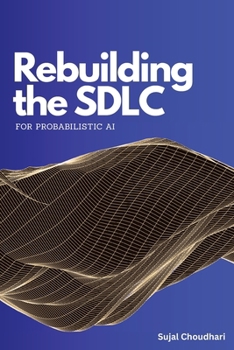
Rebuilding the SDLC for Probabilistic AI: A Practical Guide to AI-Native Software Engineering, LLM Evaluation, and Production Guardrails

For sixty years, software engineering ran on one assumption: same input, same output, every time. Large language models broke that promise, and most teams are still pretending they didn't.
Rebuilding the SDLC for Probabilistic AI is a practical guide for senior engineers, architects, and team leads who need to build reliable software on top of fundamentally unreliable components. Author Sujal Choudhari, who moved from ultra low latency C++ trading systems into AI engineering, walks through why manual vibe checks and eyeballing outputs do not scale, and what to build instead.
Inside, you will learn how to:
Design architectural guardrails that enforce structure at the token levelBuild context aware data pipelines that ground model outputs in factReplace exact match assertions with statistical evaluation pipelines using bootstrap resamplingScale QA using LLM as a judge techniques, and calibrate those judges properlyMonitor for silent semantic drift in production before your users noticeStructure engineering teams for AI native developmentThis is not management fluff or AI hype. It is a concrete, opinionated engineering framework for anyone tasked with shipping AI powered systems that actually hold up in production.
Customer Reviews
ThriftBooks ® and the ThriftBooks ® logo are registered trademarks of Thrift Books Global, LLC
