


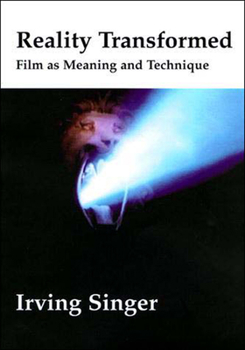
Reality Transformed: Film and Meaning and Technique
No Customer Reviews

Select Format
Select Condition 
Book Overview
A new look at film that succeeds in combining the realist and formalist sides of an ongoing debate.
In Reality Transformed Irving Singer offers a new approach to the philosophy of film. Returning to the classical debate between realists and formalists, he shows how the opposing positions may be harmonized and united. Singer concentrates on questions about appearance and reality, the visual and the literary, and the interplay between communication as a goal and alienation as a hazard in films of every sort. In three exemplary chapters, he provides suggestive readings of Woody Allen's The Purple Rose of Cairo, Luchino Visconti's Death in Venice, and Jean Renoir's The Rules of the Game. Reality Transformed will interest the general reader as well as students in all fields related to film studies.
Format:Paperback
Language:English
ISBN:0262692481
ISBN13:9780262692489
Release Date:August 2000
Publisher:MIT Press
Length:230 Pages
Weight:0.85 lbs.
Dimensions:0.5" x 5.6" x 8.7"
Age Range:18 years and up
Grade Range:Postsecondary and higher
Related Subjects
Arts, Music & Photography Film & Television Humor & Entertainment Movies Performing ArtsCustomer Reviews
0 rating
Copyright © 2026 Thriftbooks.com
Terms of Use | Privacy Policy | Do Not Sell/Share My Personal Information | Cookie Notice | Cookie Preferences | Accessibility Statement
ThriftBooks ® and the ThriftBooks ® logo are registered trademarks of Thrift Books Global, LLC
ThriftBooks ® and the ThriftBooks ® logo are registered trademarks of Thrift Books Global, LLC
