


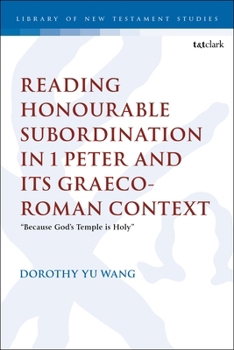
Reading Honourable Subordination in 1 Peter and Its Graeco-Roman Context
No Customer Reviews

Dorothy Wu Yang reads 1 Peter through the lens of honour and shame in the first-century Graeco-Roman world, concentrating on the theme of 'honourable subordination.' Focusing on how the epistle instructs its audience to be subordinate to the emperor, local governors and within personal relationships, Yang questions whether the letter truly encourages conformity to prevailing social norms and values of the time. She thus explores how 1 Peter's contemporaries would have perceived subordination, whether subordination be viewed positively or even honourably, and under what circumstances.
Yang first examines honour and shame in the first-century Mediterranean and the Graeco-Roman world, analysing notable first-century authors such Dio Chrysostom, Plutarch, Epictetus and Josephus, along with popular morality sayings widely circulated across the Roman Empire during this period. She argues that, seeing how his contemporaries wrote on subordination, it becomes clear that the author of 1 Peter strategically tailors his teachings to transform the concept of 'honourable subordination' under God, the final arbiter of honour and shame. Yang provides a thorough study of how an early Christian writer, navigating a cross-cultural setting, responded to societal pressures and guided his audience in a hostile environment, and how his guidance enabled them to engage positively with society while maintaining their Christian identity and value.Format:Hardcover
Language:English
ISBN:0567733785
ISBN13:9780567733788
Release Date:January 1
Publisher:T&T Clark
Length:208 Pages
Weight:1.00 lbs.
Dimensions:1.0" x 6.1" x 9.2"
Customer Reviews
0 rating
Copyright © 2026 Thriftbooks.com
Terms of Use | Privacy Policy | Do Not Sell/Share My Personal Information | Cookie Notice | Cookie Preferences | Accessibility Statement
ThriftBooks ® and the ThriftBooks ® logo are registered trademarks of Thrift Books Global, LLC
ThriftBooks ® and the ThriftBooks ® logo are registered trademarks of Thrift Books Global, LLC
