


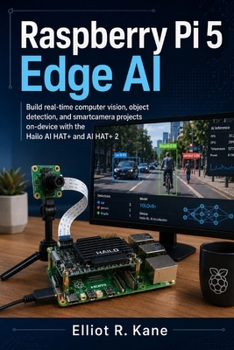
Raspberry Pi 5 Edge AI: Build real-time computer vision, object detection, and smartcamera projects on-device with the Hailo AI HAT+ and AI HAT+ 2

Turn your Raspberry Pi 5 into a private, real time AI system that sees, understands, and reacts to the world around it.
Raspberry Pi 5 Edge AI is a practical, project based guide to running modern artificial intelligence directly on the Raspberry Pi 5 using the Hailo AI HAT+ and AI HAT+ 2. Instead of sending camera feeds to cloud services, you will learn how to process vision locally, reduce latency, keep data private, operate without an internet connection, and avoid recurring cloud inference fees.
The book takes you from your first hardware setup to a complete edge AI monitoring system. You will work with Raspberry Pi 5, Camera Module 3, Raspberry Pi OS, Python, picamera2, Hailo accelerators, YOLO models, neural processing units, and real time inference pipelines.
At the center of the book is PiSentry, a complete on device AI security and monitoring camera that grows chapter by chapter. You begin with live object detection, then add tracking, zones, event detection, video recording, notifications, a live dashboard, multiple camera streams, custom trained models, GPIO control, and smart home integration. The finished system is packaged to start automatically, recover from failures, and operate unattended.
Inside, you will learn how to:
- Assemble and configure a Raspberry Pi 5 edge AI system with the Hailo AI HAT+ or AI HAT+ 2.
- Understand CPUs, GPUs, NPUs, TOPS, inference, model formats, and the role of dedicated AI acceleration.
- Capture and process camera feeds using picamera2 and Python.
- Run real time YOLO object detection with Hailo accelerators.
- Work with bounding boxes, confidence thresholds, pose estimation, and instance segmentation.
- Convert raw detections into useful events using tracking, zones, and debouncing.
- Build an intelligent security camera that records clips when meaningful activity occurs.
- Send notifications and serve a live monitoring dashboard.
- Process multiple camera streams and improve inference performance.
- Train a custom object detector and deploy the finished model to the Hailo NPU.
- Add voice and audio AI to Raspberry Pi projects.
- Connect AI decisions to GPIO devices, relays, lights, pan tilt hardware, and home automation systems.
- Package projects as dependable appliances that start on boot and run unattended.
- Apply the same techniques to wildlife monitoring, people counting, workshop monitoring, robotics, and other edge AI applications.
You will also learn the practical engineering decisions that determine whether an edge AI project works reliably, including active cooling, power requirements, storage choices, PCIe limitations, model selection, frame rates, and the differences between the 13 TOPS Hailo 8L, 26 TOPS Hailo 8, and 40 TOPS Hailo 10H accelerators.
The book is designed around hands on learning. Each stage builds toward a working system rather than isolated demonstrations. Alongside PiSentry, smaller projects show how the same capture, infer, decide, and act workflow applies to wildlife cameras, occupancy counters, automation systems, and robotics.
Whether you are a Raspberry Pi enthusiast, Python developer, maker, electronics hobbyist, computer vision learner, or developer interested in private local AI, Raspberry Pi 5 Edge AI gives you a structured path from basic inference to deployable edge AI applications.
Build AI that runs where your data is created. Keep the processing local. Build systems that see, decide, and act in real time.
Customer Reviews
ThriftBooks ® and the ThriftBooks ® logo are registered trademarks of Thrift Books Global, LLC
