


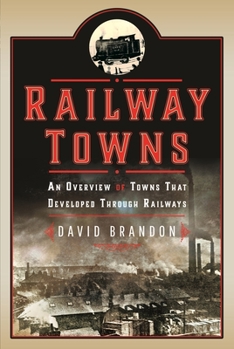
Railway Towns: An Overview of Towns That Developed Through Railways
No Customer Reviews

The railways changed the world. They initiated a revolution in communications which continues to this day, ever more profoundly influencing our lives. They had an enormous economic and social impact in Britain, not least with its demography. Before 1914 places on the railway system felt they were connected to the wider world. Those left off the system often feared for their future.
It was never actually as simple as that. Some places well served by railways prospered, other did not. Some with minimal or no railway connections managed to sustain themselves successfully. Others became complex railway hubs, perhaps with railway-based engineering works, extensive shunting yards and warehouses and a large requirement for labour. Some companies built large numbers of dwellings for their workers and their families. Sometimes they even built churches and parks, for example.
Places of this character have often been described as 'railway towns' but what is actually meant by this term?
In a pioneering attempt in book form to move towards an understanding of what constitutes a railway town, the author considers a wide range of cities, towns, villages and other settlements and asks to what extent they owed their nineteenth and early twentieth century development to the railways.
This book should appeal to students of railway history, British topography and the economic, social and cultural impact of railways.
It was never actually as simple as that. Some places well served by railways prospered, other did not. Some with minimal or no railway connections managed to sustain themselves successfully. Others became complex railway hubs, perhaps with railway-based engineering works, extensive shunting yards and warehouses and a large requirement for labour. Some companies built large numbers of dwellings for their workers and their families. Sometimes they even built churches and parks, for example.
Places of this character have often been described as 'railway towns' but what is actually meant by this term?
In a pioneering attempt in book form to move towards an understanding of what constitutes a railway town, the author considers a wide range of cities, towns, villages and other settlements and asks to what extent they owed their nineteenth and early twentieth century development to the railways.
This book should appeal to students of railway history, British topography and the economic, social and cultural impact of railways.
Format:Hardcover
Language:English
ISBN:1399051075
ISBN13:9781399051071
Release Date:April 2024
Publisher:Pen and Sword Transport
Length:224 Pages
Customer Reviews
0 rating
Copyright © 2026 Thriftbooks.com
Terms of Use | Privacy Policy | Do Not Sell/Share My Personal Information | Cookie Policy | Cookie Preferences | Accessibility Statement
ThriftBooks ® and the ThriftBooks ® logo are registered trademarks of Thrift Books Global, LLC
ThriftBooks ® and the ThriftBooks ® logo are registered trademarks of Thrift Books Global, LLC
