


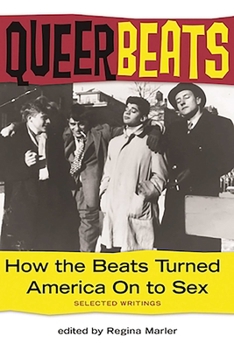
Queer Beats: How the Beats Turned America on to Sex

Select Format
Select Condition 
Book Overview
The writings that shocked America out of the 1950s Blasting through the crew-cuts and conformism of their day, the Beat writers were queer in the fullest sense of the word: their fluid sexuality challenged all sexual and romantic conventions. Most shocking of their unconventional attitudes was their embrace of same-sex eroticism. At a time when gay people were considered mentally ill or criminal, the Beats celebrated spontaneity and freedom in thought, word, and action. Their highest value was nakedness--even before Allen Ginsberg stripped bare at a poetry reading to silence a heckler. They would try anything once, then write about it. Queer Beats: How the Beats Turned America On to Sex traces, for the first time, the queer pulse that throbs throughout the Beats' writings--from William S. Burroughs's Naked Lunch and Allen Ginsberg's wistful, boy-loving sex poems to Jack Kerouac's hero-worship of Neal Cassady--and Kerouac's denial of having sex with men, despite erotic encounters with Ginsberg and Gore Vidal: "Posterity will laugh at me if it thinks I was queer."
Format:Paperback
Language:English
ISBN:1573441880
ISBN13:9781573441889
Release Date:August 2004
Publisher:Cleis Press
Length:209 Pages
Weight:0.85 lbs.
Dimensions:0.8" x 6.0" x 9.0"
Customer Reviews
2 ratings
The best Beat book I've read in years!
Published by Thriftbooks.com User , 22 years ago
For anyone who thinks they've heard it all--and even for those who haven't--Queer Beats breaks through a new door of history of this much loved group of writers. Regina Marler has brought together a fun and fascinating array of stories, letters, poems, and journals that I simply could not put down. Rarely have I seen the Beats handled so throughly and deftly by one writer. That she tackles the hot topic of sexuality as expertly as she does on top of all else is doubly impressive. Marler's introductory essays are also so full of Beat lore, gossip and sex that her own writing is worth the price of the book alone! Aftering reading this, you'll never look at the Beats the same again.
A FRESH TAKE ON AMERICA'S BEAT WRITERS
Published by Thriftbooks.com User , 22 years ago
For latecomers who may have only read one or two canonic Beat works (say ON THE ROAD and "Howl"), or for those who once read masses of the stuff but never grasped the overall flow of the movement, Regina Marler's introduction to QUEER BEATS is invaluable. She charts their progress from Ginsberg's 1948 experience, part sexual, part religious, of "hearing" William Blake read his poems in a voice like that of God, down through the notoriety and popularization of "beatniks," to the historic legal decisions of 1957-66 that lifted the bans against "Howl," Henry Miller's TROPIC OF CANCER, and NAKED LUNCH, and forever changed what could be published in America. The major players are represented by characteristic yet unhackneyed extracts. For once, Kerouac's 1948 remark about Posterity (see jacket copy above) is set into context: he was still an unknown, though convinced of his destiny. Several Burroughs "routines" reveal him to be one of the granddaddies of the Goths. But it is Ginsberg who emerges as the real motive force here, writing, proselytizing, using publicity to make political statements, and networking like a pro. Thanks to dedicated digging in the archives, Marler is also able to highlight interesting ancillary figures such as Herbert Huncke and John Giorno, poets Alan Ansen and Harold Norse, and Ginsberg's lover and helpmeet Peter Orlovsky, who must have been one sweet guy despite not having much brain. Norman Mailer, Gore Vidal, and the legendary Neal Cassady stop by for cameo performances. Other selections attain high comedy, as in Jane Bowles's off-the-wall tale of lesbian attraction and repulsion, or Diane di Prima's precise deadpan chronicle of the interactions at an orgy where she and Kerouac were the hetero centerpiece. Not every selection is of top literary merit, perhaps, but Marler's introductory notes place each item into a cunning assemblage larger than its parts. The wry company of the unflappable editor enhances this anthology's attractions: there isn't a dull page in the book (which Cleis Press has provided with a handsome, uncluttered presentation). The fitting climax is provided by expatriate Paul Bowles, connected to all the Beats though not one of them. His twenty-four page short story "Pages from Cold Point" is a masterpiece of ambiguous anxiety and sexual blackmail: if you've never read it, read it here. QUEER BEATS: HOW THE BEATS TURNED AMERICA ON TO SEX revives rare, overlooked, and unusual work. As the pioneering collection of its kind, Marler's book not only enlarges our view of homegrown American literature, but suggests plenty of possibilities for further exploration. Enjoy it!
Copyright © 2026 Thriftbooks.com
Terms of Use | Privacy Policy | Do Not Sell/Share My Personal Information | Cookie Notice | Cookie Preferences | Accessibility Statement
ThriftBooks ® and the ThriftBooks ® logo are registered trademarks of Thrift Books Global, LLC
ThriftBooks ® and the ThriftBooks ® logo are registered trademarks of Thrift Books Global, LLC
