


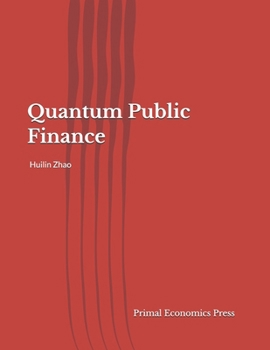
Quantum Public Finance
No Customer Reviews

Public economics addresses market failures, public goods, taxation, and government behavior, yet has long relied on two fictional constructs: the perfectly rational economic agent and the benevolent, omniscient state. This approach has yielded elegant results-such as the Samuelson condition and optimal tax formulas-yet has incurred cumulative failures: the inability to anticipate fiscal confidence crises, the inability to explain voter behavior and taxpayer compliance, and the inability to account for why the same society can become locked into fundamentally different models of welfare states. Public choice theory, behavioral economics, and the information revolution have dismantled these two myths, replacing their unified framework with a list of disparate findings. Consequently, the false dichotomy between the state and the market persists, perpetually forcing hybrid forms of governance into rigid boxes.
Quantum Public Economics argues that the mathematical language of quantum mechanics-Hilbert spaces, state vectors, superposition, entanglement, measurement collapse, unitary evolution, decoherence, and phase transitions-provides precisely the appropriate language for describing collective, context-dependent public life. This thesis is grounded in a practical ontology: public agents, institutions, and policies possess mathematical structures analogous to quantum states, rather than asserting that the state is a quantum machine. Public decision-making constitutes a measurement of collective choice; the fact that the sequence and framing of deliberations alter outcomes stems from the non-commutative nature of underlying judgments. The choices of citizens, governments at all levels, and the state are entangled; framing, expressive voting, tax ethics, path dependence, and global free-riding thus emerge as predictable imprints of this unified process. The book is organized into six parts comprising thirty chapters. The first part examines the century-long crisis of the classical paradigm, critiques its mechanistic nature, establishes a practical ontology and relational realism, and proposes the concept of a "quantum public subject"; the second part reconstructs theories of market failure-covering public goods, externalities, information asymmetry, and monopolies-based on the principles of superposition and entanglement; the third part re-examines public choice and collective action, ranging from voting paradoxes, free-riding, interest groups, and bureaucratic failures to deliberative democracy; the fourth part develops a quantum taxation theory, addressing tax obligations, the allocation of tax burdens within entangled networks, optimal taxation, behavioral responses, and the evolution of tax systems under digital challenges; the fifth part shifts focus to public expenditure, social security, the measurement of inequality, public service provision, and the evolution of welfare states; the sixth part extends the scope to fiscal federalism, government regulation, the digital public economy, global public goods, and the future of common prosperity. This book is intended for senior undergraduates, graduate students, economists, and policy researchers.
Quantum Public Economics argues that the mathematical language of quantum mechanics-Hilbert spaces, state vectors, superposition, entanglement, measurement collapse, unitary evolution, decoherence, and phase transitions-provides precisely the appropriate language for describing collective, context-dependent public life. This thesis is grounded in a practical ontology: public agents, institutions, and policies possess mathematical structures analogous to quantum states, rather than asserting that the state is a quantum machine. Public decision-making constitutes a measurement of collective choice; the fact that the sequence and framing of deliberations alter outcomes stems from the non-commutative nature of underlying judgments. The choices of citizens, governments at all levels, and the state are entangled; framing, expressive voting, tax ethics, path dependence, and global free-riding thus emerge as predictable imprints of this unified process. The book is organized into six parts comprising thirty chapters. The first part examines the century-long crisis of the classical paradigm, critiques its mechanistic nature, establishes a practical ontology and relational realism, and proposes the concept of a "quantum public subject"; the second part reconstructs theories of market failure-covering public goods, externalities, information asymmetry, and monopolies-based on the principles of superposition and entanglement; the third part re-examines public choice and collective action, ranging from voting paradoxes, free-riding, interest groups, and bureaucratic failures to deliberative democracy; the fourth part develops a quantum taxation theory, addressing tax obligations, the allocation of tax burdens within entangled networks, optimal taxation, behavioral responses, and the evolution of tax systems under digital challenges; the fifth part shifts focus to public expenditure, social security, the measurement of inequality, public service provision, and the evolution of welfare states; the sixth part extends the scope to fiscal federalism, government regulation, the digital public economy, global public goods, and the future of common prosperity. This book is intended for senior undergraduates, graduate students, economists, and policy researchers.
Format:Paperback
Language:English
ISBN:B0HJJ22FYP
ISBN13:9798905891236
Release Date:September 2026
Publisher:Primal Economics Press
Length:502 Pages
Weight:2.54 lbs.
Dimensions:1.0" x 8.5" x 11.0"
Customer Reviews
0 rating
Copyright © 2026 Thriftbooks.com
Terms of Use | Privacy Policy | Do Not Sell/Share My Personal Information | Cookie Notice | Cookie Preferences | Accessibility Statement
ThriftBooks ® and the ThriftBooks ® logo are registered trademarks of Thrift Books Global, LLC
ThriftBooks ® and the ThriftBooks ® logo are registered trademarks of Thrift Books Global, LLC
