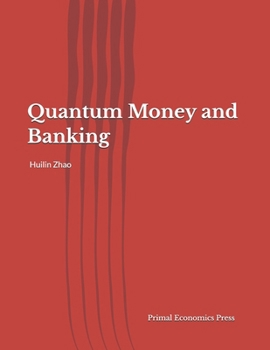
Quantum Money and Banking
No Customer Reviews

Money and banking constitute the circulatory system of the modern economy. Since Gresham's Law, theories in this field have evolved over five centuries, forming an imposing theoretical edifice founded on the monetary veil hypothesis, exogenous money supply, single equilibrium interest rates, the efficient market hypothesis, and linear transmission chains. Nevertheless, the 2008 global financial crisis witnessed instantaneous evaporation of liquidity across entangled balance sheets. Post-pandemic central bank balance sheet expansion and the resurgence of inflation contradicted the stable money multiplier and the Phillips curve. Shadow banking, cryptoassets, stablecoins and central bank digital currencies coexist in superposition. Quantitative easing transmits through expectations via measurement rather than mechanical mechanisms - the mechanistic paradigm has been stretched to its breaking point. This monograph is the first to systematically establish quantum money and banking theory. It introduces Hilbert spaces, state vectors, superposition, entanglement, measurement collapse, the Born rule, unitary evolution, decoherence, tunneling and quantum phase transitions into money, banking and finance as a formal ontology, rather than loose analogies. Monetary value is a relational state of superposition; supply and demand are entangled observables; banks function as entangled nodes within credit networks; credit creation is an emergent process; and financial crises represent quantum phase transitions triggered under critical stress.
The book contains six parts and thirty chapters. Part I lays the paradigmatic and philosophical foundations and puts forward quantum monetary agents together with a five-dimensional analytical framework. Part II constructs quantum monetary theory, exploring the nature of money, supply-demand entanglement, interest-rate superposition, tunneling in monetary circulation, and digital currencies. Part III develops quantum banking theory, covering banks as entangled nodes, quantum portfolios of assets and liabilities, the emergence of credit creation, quantum macroprudential regulation, and central banking. Part IV addresses quantum financial markets, ranging from the efficient market hypothesis to money markets, capital markets, foreign exchange markets and derivatives. Part V deals with quantum monetary policy and financial stability, including transmission networks, double-well inflation, phase transitions in financial crises and macroeconomic resilience. Part VI extends the framework to the digital economy, green finance, fintech, RMB internationalization and the multipolar monetary order.
Classical results are rigorously preserved as limiting cases under decoherence and zero-interference conditions. This book is intended for graduate students and faculty in finance, money and banking, as well as practitioners from central banks, regulatory authorities and financial institutions.
Format:Paperback
Language:English
ISBN:B0HJLV2QPG
ISBN13:9798905891250
Release Date:September 2026
Publisher:Primal Economics Press
Length:442 Pages
Weight:2.24 lbs.
Dimensions:0.9" x 8.5" x 11.0"
Customer Reviews
0 rating
Copyright © 2026 Thriftbooks.com
Terms of Use | Privacy Policy | Do Not Sell/Share My Personal Information | Cookie Notice | Cookie Preferences | Accessibility Statement
ThriftBooks ® and the ThriftBooks ® logo are registered trademarks of Thrift Books Global, LLC