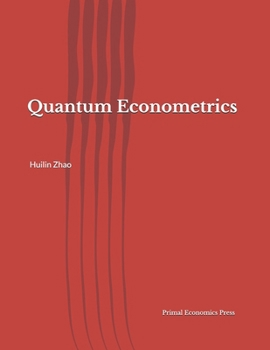
Quantum Econometrics
No Customer Reviews

Econometrics has equipped the social sciences with powerful tools for estimating structural relations from noisy data, separating signal from chance, and reasoning rigorously about cause and effect in non-experimental systems. Yet its edifice rests on four inherited assumptions-linear relations, independent observations, an observer outside the system, and uncertainty governed by the classical Kolmogorov calculus-that fail systematically in an economy of interacting agents, high-dimensional data and reflexive markets. This book is the first monograph to rebuild the inferential foundations of economics as quantum econometrics. Arguing that the formal structure of economic reality is quantum-relational, it imports the calculus of Hilbert space, state vectors, superposition, entanglement, interference and measurement collapse into estimation and inference-not as metaphor but as a testable formal programme in which every quantum mechanism does genuine inferential work.
The book is organized into six parts and thirty chapters. Part I establishes the paradigm and apparatus, from the crisis of classical econometrics through quantum probability, Hilbert space, superposition, entanglement and an observer-sensitive measurement theory. Part II builds the core of quantum estimation and causal identification: quantum regression, maximum likelihood, Bayesian inference, the method of moments and GMM, and instrumental-variable identification. Part III adapts the framework to panel, time-series, volatility, discrete-choice, nonparametric and semiparametric models, and to quantum machine learning. Part IV is devoted to financial econometrics-asset pricing, tail-risk measurement and portfolio optimization. Part V carries the framework across macro, spatial, behavioural, development, environmental, labour, international and industrial-organization econometrics. Part VI looks outward to quantum computing and synthesizes the discipline's future.
This book rigorously preserves the classic results in the limits of decoherence, zero phase, and single eigenstates. It is intended for graduate students and faculty in the fields of economics, statistics, and finance, as well as for applied econometric researchers engaged in causal inference, time series analysis, and risk management.
The book is organized into six parts and thirty chapters. Part I establishes the paradigm and apparatus, from the crisis of classical econometrics through quantum probability, Hilbert space, superposition, entanglement and an observer-sensitive measurement theory. Part II builds the core of quantum estimation and causal identification: quantum regression, maximum likelihood, Bayesian inference, the method of moments and GMM, and instrumental-variable identification. Part III adapts the framework to panel, time-series, volatility, discrete-choice, nonparametric and semiparametric models, and to quantum machine learning. Part IV is devoted to financial econometrics-asset pricing, tail-risk measurement and portfolio optimization. Part V carries the framework across macro, spatial, behavioural, development, environmental, labour, international and industrial-organization econometrics. Part VI looks outward to quantum computing and synthesizes the discipline's future.
This book rigorously preserves the classic results in the limits of decoherence, zero phase, and single eigenstates. It is intended for graduate students and faculty in the fields of economics, statistics, and finance, as well as for applied econometric researchers engaged in causal inference, time series analysis, and risk management.
Format:Paperback
Language:English
ISBN:B0HJPYNW23
ISBN13:9798905891342
Release Date:September 2026
Publisher:Primal Economics Press
Length:542 Pages
Weight:2.73 lbs.
Dimensions:1.1" x 8.5" x 11.0"
Customer Reviews
0 rating
Copyright © 2026 Thriftbooks.com
Terms of Use | Privacy Policy | Do Not Sell/Share My Personal Information | Cookie Notice | Cookie Preferences | Accessibility Statement
ThriftBooks ® and the ThriftBooks ® logo are registered trademarks of Thrift Books Global, LLC
ThriftBooks ® and the ThriftBooks ® logo are registered trademarks of Thrift Books Global, LLC