


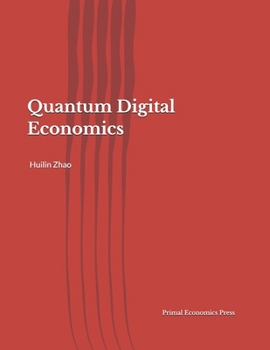
Quantum Digital Economics
No Customer Reviews

The digital economy marks the most farreaching economic transformation since industrialization: data has become a nonrival, replicable factor of production whose value increases with repeated use; networks form the basic organizational architecture; algorithms serve as resource allocation mechanisms; platforms operate as hubs matching supply and demand; and artificial intelligence undertakes cognitive labour once exclusive to human beings. Mainstream digital economics responds by patching the neoclassical analytical framework - treating data as a special capital good, platforms as special firms, and network effects as a distinctive type of externality. Yet the intrinsic properties of digital reality, namely increasing returns, disequilibrium, the blurring boundary between firms and markets, algorithmshaped preferences, and systemic emergence arising from multiagent feedback, strike at the foundational underpinnings of this framework.
This monograph is the world's first systematic treatise on quantum digital economics. Drawing on digital states superposed in Hilbert space, measurement collapse following the Born rule, entanglement among users, platforms, data and algorithms, criticalmass phase transitions and decoherence limits, it develops a unified analytical language for information economics, twosided market theory, complexity studies and behavioural economics. Rather than overturning classical digital economics, quantum digital economics generalizes it, rendering the dependence of economic outcomes on contexts, measurement bases, interaction sequences and network positions explicit and empirically testable.
The book is organized into six parts, each consisting of five chapters. Part I, Foundations and Paradigm Revolution, diagnoses the crisis of the prevailing paradigm, traces its mechanistic intellectual origins, establishes a practical ontology, proposes the quantum digital agent, and constructs the overarching analytical framework. Part II, A Quantum Theory of Data as a Factor of Production, investigates the superpositional nature of data, the bundle of property rights, emergent value and contextual collapse pricing, the tradeoff between data flow and privacy protection, and the disequilibrium evolution of data markets. Part III, Platforms, Networks and Market Structure, elaborates the dynamics of network effects, superposition pricing and crossside entanglement in twosided markets, platform ecosystems, the internal mechanisms of digital monopoly and corresponding governance approaches. Part IV, Algorithms, Intelligence and Digital Organizations, examines algorithmic pricing, recommendation systems and preference collapse, artificial intelligence as an economic agent, selforganizing firms, and gig labour under algorithmic governance. Part V, Digital Currencies, Finance and Macroeconomic Emergence, covers matching mechanisms and trust formation, digital currencies and payment systems, inclusive finance, blockchains and digital assets, and digital macroeconomic regulation. Part VI, Globalization, Governance and Intelligent Society, addresses digital trade and valuechain restructuring, nonlinear innovation, digital inequality, algorithmic public decisionmaking, and the developmental landscape of intelligent societies.
The book adheres to three academic principles: the quantum analytical apparatus delivers substantive explanatory power, while classical economic results are recovered as special cases under decoherence limits; every theoretical proposition is grounded in concrete causal mechanisms and yields observable implications; the theory is constructed for realworld application. It is intended for researchers and graduate students in digital economy, as well as platform managers.
Format:Paperback
Language:English
ISBN:B0HJNY7524
ISBN13:9798905891434
Release Date:September 2026
Publisher:Primal Economics Press
Length:454 Pages
Weight:2.30 lbs.
Dimensions:0.9" x 8.5" x 11.0"
Customer Reviews
0 rating
Copyright © 2026 Thriftbooks.com
Terms of Use | Privacy Policy | Do Not Sell/Share My Personal Information | Cookie Notice | Cookie Preferences | Accessibility Statement
ThriftBooks ® and the ThriftBooks ® logo are registered trademarks of Thrift Books Global, LLC
ThriftBooks ® and the ThriftBooks ® logo are registered trademarks of Thrift Books Global, LLC
