


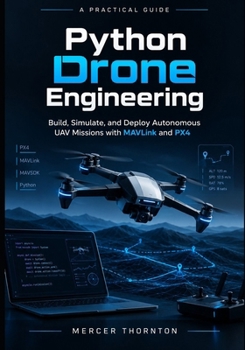
Python Drone Engineering: Build, Simulate, and Deploy Autonomous UAV Missions with MAVLink and PX4

What if you could write Python programs that communicate with a drone, monitor its flight data, and carry out autonomous missions?
Python Drone Engineering is a practical guide to connecting Python programming with modern drone technology. Through hands-on examples, simulation exercises, and guided projects, Mercer Thornton shows you how to build the software skills needed to control, monitor, and develop autonomous unmanned aerial vehicle (UAV) systems.
Rather than starting with expensive hardware, this book takes a simulation-first approach. You will learn to work with Python, PX4, MAVLink, MAVSDK, Gazebo, and QGroundControl, building your understanding step by step before moving toward real-world applications.
WHAT YOU WILL LEARNSet Up Your Development Environment: Configure the essential tools and run your first simulated PX4 drone.Program Drones with Python: Apply functions, classes, asynchronous programming, error handling, and logging to drone projects.Connect to a Drone: Establish communication with a vehicle using MAVLink and MAVSDK, then check its status and system health.Read and Analyze Telemetry: Monitor altitude, position, attitude, velocity, battery levels, GPS information, and flight modes.Send Flight Commands: Learn the software workflow for arming, takeoff, landing, and returning to launch.Build Autonomous Missions: Plan GPS waypoint routes, upload missions, and monitor their executionDevelop Safer Drone Software: Implement preflight checks, flight-state logic, geofencing concepts, and responses to communication failuresCreate Custom Flight Patterns: Work with position and velocity commands to develop circular, square, and grid-based paths.Build a Survey and Patrol Project: Apply your skills to a practical workflow involving GPS boundaries, telemetry, events, and flight-path analysis.Prepare for Real Hardware: Understand equipment selection, bench testing, firmware setup, and the checks needed before controlled autonomous flights.WHO IS THIS BOOK FORThis book is designed for readers who already understand basic Python programming and want to apply it to robotics and autonomous flight.
Python programmers interested in drones and roboticsEngineering and computer science students working on UAV projectsDrone hobbyists who want to move beyond manual flightDevelopers learning PX4, MAVLink, and autonomous mission programmingSurveying, agriculture, inspection, and mapping professionals interested in drone-based workflowsIndependent learners who prefer practical examples over theory aloneYou do not need to own a drone to get started. Much of the learning takes place in simulation, allowing you to develop and test your programs before working with physical equipment
A PRACTICAL APPROACH TO AUTONOMOUS FLIGHTWriting drone software involves more than sending a command and expecting the aircraft to respond. Reliable programs must account for vehicle state, telemetry, communication problems, timeouts, and safety procedures
This guide emphasizes small, testable programs, clear error reporting, telemetry logging, and sensible validation practices. It also explains the relationship between your Python application and the flight controller, helping you understand where high-level mission logic ends and onboard flight stabilization begins
By the end, you will have a stronger foundation for developing Python-based drone applications, planning autonomous UAV missions, and extending your skills into more advanced robotics projects
Start building your drone programming skills with Python, one practical project at a timeCustomer Reviews
ThriftBooks ® and the ThriftBooks ® logo are registered trademarks of Thrift Books Global, LLC
