


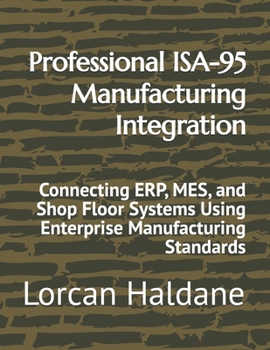
Professional ISA-95 Manufacturing Integration: Connecting ERP, MES, and Shop Floor Systems Using Enterprise Manufacturing Standards

A practical guide to connecting business planning with real manufacturing operations. This book explains how ISA-95 can be used to align ERP, MES, and shop floor systems so information flows cleanly from order entry to execution, reporting, and traceability. It is written for teams that need a structured way to connect enterprise processes with plant-floor realities without losing control of data, timing, or accountability.
The book starts with the terminology, hierarchy, and information model behind ISA-95, then moves into the core design work required for real integration projects. Readers will learn how to define sites, areas, lines, work centers, equipment, resources, and identifiers in a consistent way, and how to treat master data as a governed asset rather than a collection of disconnected fields.
Inside, you will find coverage of:
ISA-95 scope, architecture, and enterprise to control-system boundariesERP to MES process exchange, including orders, schedules, work orders, and revisionsMES to shop floor execution, status updates, events, measurements, and quality resultsData mapping, canonical models, unit handling, timestamps, and identifier consistencyMessage design, interface patterns, validation, error handling, and idempotencyMiddleware, APIs, integration services, security, and orchestration approachesScheduling, dispatching, downtime, actuals capture, quality, and traceabilityTesting, monitoring, auditability, and readiness checks for production useEach chapter includes a practical example, making the material useful not just for architects and engineers, but also for manufacturing IT leaders, operations managers, MES implementers, and integration teams. The examples show how to translate theory into working solutions, from pilot models to multi-site environments with shared resources and mixed manufacturing modes.
What makes this book especially useful is its focus on implementation decisions. It does not stop at standards terminology. It shows how to model resources, manage change, preserve traceability, and build interfaces that can survive real production conditions, such as duplicate messages, interruptions, rescheduling, and inconsistent reference data.
Several case studies close the book, covering discrete, batch, and mixed-mode manufacturing scenarios. The included checklists and deployment guidance provide a clear foundation for teams preparing an ISA-95-based integration initiative, whether the goal is better scheduling, stronger quality control, more reliable execution, or more accurate performance reporting.
For organizations trying to connect planning systems with plant-floor execution in a disciplined way, this book offers a clear framework and a working roadmap.
Customer Reviews
ThriftBooks ® and the ThriftBooks ® logo are registered trademarks of Thrift Books Global, LLC
