


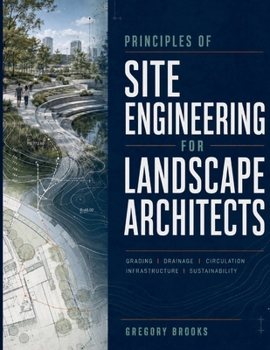
Principles of Site Engineering for Landscape Architects: A Practical Guide to Grading, Drainage, Stormwater, Earthwork, Accessibility, and Constructio
No Customer Reviews

Turn strong design ideas into terrain, water, circulation, and construction decisions that can be measured, coordinated, and built.
Many landscape-architecture students and early-career practitioners can see the spatial potential of a site yet feel less certain when the work shifts to survey control, proposed contours, drainage paths, earthwork quantities, or technical coordination. A compelling concept is only the beginning. The site must also drain, connect, meet dimensional requirements, respond to existing conditions, and communicate clear intent to the people who will price and build it.
This practical reference closes that gap by treating site engineering as an integrated design discipline. It moves from measurement and terrain reading to grading, water movement, circulation, retaining conditions, utilities, materials, layout, and construction documentation. Explanations connect formulas to design judgment, while worked examples show intermediate steps so readers can follow not only what to calculate, but why the result matters. Practice problems and answer support encourage active learning instead of passive review.
The sequence is designed to help readers recognize relationships that are often taught separately: how survey information controls layout, how proposed elevations shape accessible movement, how grading directs runoff, how stormwater strategies affect landform and materials, and how technical decisions must remain consistent across drawings and quantities. The result is a repeatable way to move from existing conditions to coordinated site information.
Use this book to: read survey control, topography, contours, slopes, and terrain relationships with greater confidencedevelop proposed grading that balances drainage, usability, landform, and constructabilitycalculate cut-and-fill quantities and interpret what earthwork numbers mean for design decisionsestimate runoff and work through surface-drainage and hydraulic-conveyance problems step by stepcoordinate circulation, inclusive routes, parking, retaining conditions, erosion control, and utilitiestranslate calculations and design intent into layout, takeoffs, quality checks, and coordinated construction documentsWritten for upper-level students, recent graduates, and developing practitioners, the book can support technical coursework, studio projects, internship growth, licensing preparation, and day-to-day reference. It explains software-independent principles in accessible language and uses customary units with selected metric context. It is an educational foundation-not a substitute for project-specific professional services or current jurisdictional requirements. If you want to connect design thinking with disciplined technical reasoning, begin here and build a more confident site-engineering workflow.
Many landscape-architecture students and early-career practitioners can see the spatial potential of a site yet feel less certain when the work shifts to survey control, proposed contours, drainage paths, earthwork quantities, or technical coordination. A compelling concept is only the beginning. The site must also drain, connect, meet dimensional requirements, respond to existing conditions, and communicate clear intent to the people who will price and build it.
This practical reference closes that gap by treating site engineering as an integrated design discipline. It moves from measurement and terrain reading to grading, water movement, circulation, retaining conditions, utilities, materials, layout, and construction documentation. Explanations connect formulas to design judgment, while worked examples show intermediate steps so readers can follow not only what to calculate, but why the result matters. Practice problems and answer support encourage active learning instead of passive review.
The sequence is designed to help readers recognize relationships that are often taught separately: how survey information controls layout, how proposed elevations shape accessible movement, how grading directs runoff, how stormwater strategies affect landform and materials, and how technical decisions must remain consistent across drawings and quantities. The result is a repeatable way to move from existing conditions to coordinated site information.
Use this book to: read survey control, topography, contours, slopes, and terrain relationships with greater confidencedevelop proposed grading that balances drainage, usability, landform, and constructabilitycalculate cut-and-fill quantities and interpret what earthwork numbers mean for design decisionsestimate runoff and work through surface-drainage and hydraulic-conveyance problems step by stepcoordinate circulation, inclusive routes, parking, retaining conditions, erosion control, and utilitiestranslate calculations and design intent into layout, takeoffs, quality checks, and coordinated construction documentsWritten for upper-level students, recent graduates, and developing practitioners, the book can support technical coursework, studio projects, internship growth, licensing preparation, and day-to-day reference. It explains software-independent principles in accessible language and uses customary units with selected metric context. It is an educational foundation-not a substitute for project-specific professional services or current jurisdictional requirements. If you want to connect design thinking with disciplined technical reasoning, begin here and build a more confident site-engineering workflow.
Format:Paperback
Language:English
ISBN:B0HD9B5BLR
ISBN13:9798191175515
Release Date:August 2026
Publisher:Independently Published
Length:526 Pages
Weight:2.66 lbs.
Dimensions:1.1" x 8.5" x 11.0"
Customer Reviews
0 rating
Copyright © 2026 Thriftbooks.com
Terms of Use | Privacy Policy | Do Not Sell/Share My Personal Information | Cookie Policy | Cookie Preferences | Accessibility Statement
ThriftBooks ® and the ThriftBooks ® logo are registered trademarks of Thrift Books Global, LLC
ThriftBooks ® and the ThriftBooks ® logo are registered trademarks of Thrift Books Global, LLC
