


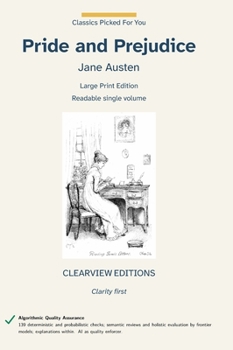
Pride and Prejudice [Large Print]

Pride and Prejudice by Jane Austen, first published in 1813, is presented here as a complete Standard large-print hardcover. This edition follows the illustrated 1894 George Allen printing transcribed in Project Gutenberg ebook 1342. It retains all sixty-one chapters of Austen's novel, George Saintsbury's preface, Hugh Thomson's illustrated matter, and the original list of illustrations. The novel is complete in one volume; this is neither an abridgment nor a modern retelling.
The Bennet household has five daughters and an inheritance that cannot pass to them directly. When Mr. Bingley comes to Netherfield and Mr. Darcy arrives with him, visits and dances quickly become matters of family strategy. Elizabeth Bennet is alert to foolishness and confident in her first judgments. Darcy's reserve invites her distrust. Their encounters turn on pride, reputation, money, and what each is willing to learn after being mistaken.
Austen gives the courtship plot a wider social life. Mrs. Bennet's urgency, Jane's patience, Lydia's impulsiveness, Charlotte Lucas's practical choices, and Mr. Collins's deference all place different pressures on Elizabeth's wish to decide for herself. Letters and reported conversations change the meaning of earlier scenes. The book is funny about manners, but its wit has consequences: a misread character or a withheld fact can alter a family's prospects.
The selected source edition brings its own historical layer. In the retained preface, George Saintsbury argues for this novel as his preferred Austen and writes especially warmly about Elizabeth. Hugh Thomson's drawings follow conversations, letters, rooms, and moments of recognition. His frontispiece, used as the exterior cover artwork for this edition, shows a woman reading a letter. The source also includes illustrated title matter, a dedication by Thomson, an original illustration list, and a Chiswick Press closing line.
Original Clearview companion pages, "A Preface and a Picture," distinguish Austen's 1813 novel from the 1894 illustrated edition and invite readers to notice how Saintsbury and Thomson approached the story. The source note identifies the selected Project Gutenberg witness and explains that page references in the original illustration list belong to the nineteenth-century printing. This newly typeset book has its own Contents and bookmarks for navigation.
The 7 by 10 inch trim uses 18-point Atkinson Hyperlegible Next body type with 27-point leading for sustained print reading. Ragged-right lines, no automatic word division, and generous inner margins give the large type room on the page. The 103 retained source image blocks are prepared as grayscale working copies for the white 50-pound black-and-white interior. Illustrated source matter is credited rather than presented as new artwork.
For libraries and reading groups, this edition offers the complete familiar novel together with the visual and critical framing of a specific later edition. Readers can follow Austen's sixty-one chapters continuously, then compare Saintsbury's stated preference and Thomson's interpretation with their own. The Standard hardcover format accommodates the full text and historical illustrations in one large-print volume. The source edition also gives readers a material reminder that a classic can carry more than one history: the history of its first publication and the history of its later presentation to new audiences.
Algorithmic Quality Assurance: 139 deterministic and probabilistic checks; semantic reviews and holistic evaluation by frontier models; explanations within. AI as quality enforcer.
Customer Reviews
ThriftBooks ® and the ThriftBooks ® logo are registered trademarks of Thrift Books Global, LLC
