


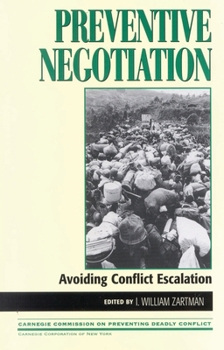
Preventive Negotiation: Avoiding Conflict Escalation


Select Format
Select Condition 
Book Overview
Negotiation lies at the core of preventive diplomacy. This study is unusual in approaching preventive diplomacy by issue areas: it looks at the way in which preventive negotiation has been practiced, notes its characteristics, and then suggests how lessons can be transferred from one area to another, but only when particular conditions warrant such a transfer. The distinguished contributing authors treat eleven issues: boundary problems, territorial claims, ethnic conflict, divided states, state disintegration, cooperative disputes, trade wars, transboundary environmental disputes, global natural disasters, global security conflicts, and labor disputes. The editor's conclusion draws out general themes about the nature of preventive diplomacy.
Format:Paperback
Language:English
ISBN:0847698955
ISBN13:9780847698950
Release Date:December 2000
Publisher:Bloomsbury Publishing USA
Length:352 Pages
Weight:1.14 lbs.
Dimensions:0.8" x 6.0" x 9.0"
Customer Reviews
1 rating
applied rationality
Published by Thriftbooks.com User , 19 years ago
Zartman's book can be read as an analysis of applied rationality. The contributors of the chapters describe valiant efforts over recent decades in preventing or minimising conflicts throughout the world. These range from the Catholic-Protestant struggles in Northern Ireland, to the seccesionist war in Chechnya, to dealing with the Korean peninsula. In the aftermath of the Cold War, much effort was expended in trying to promote a peaceful breakup of the Soviet Union. Mostly successful, Chechnya notwithstanding. Especially if you compare the results to the 5 Yugoslav wars of the 90s. An especially encouraging feature of the book is the account of how the US and Russia managed to keep their nuclear weapons negotiations running. Including preventing nuclear weapons proliferation. There is one striking omission in the book. Rwanda. The genocide in 94 was the worst event of the decade. Outdoing by far the all the Yugoslav wars or Chechnya. Perhaps its omission was due to the absence of rational players amongst the Hutu leadership. Whoever said genocide was rational?
Copyright © 2026 Thriftbooks.com
Terms of Use | Privacy Policy | Do Not Sell/Share My Personal Information | Cookie Policy | Cookie Preferences | Accessibility Statement
ThriftBooks ® and the ThriftBooks ® logo are registered trademarks of Thrift Books Global, LLC
ThriftBooks ® and the ThriftBooks ® logo are registered trademarks of Thrift Books Global, LLC
