


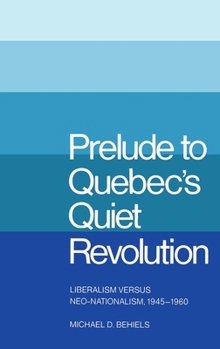
Prelude to Quebec's Quiet Revolution: Liberalism Vs Neo-Nationalism, 1945-60
No Customer Reviews

Select Format
Select Condition 
Book Overview
The traditional nationalism of French Canada began to crumble after the Second World War. It had been based on a rural, elitist societal structure in which control of education, health, and social services was firmly in the hands of the Catholic church.
Two competing movements emerged in the 1940s to challenge the traditional ideology. One espoused neo-nationalism, the other liberalism. Both were made up of young, dedicated intellectuals and journalists; together they represent the ideological roots of Quebec's Quiet Revolution. The neo-nationalists were associated with Le Devoir and l'Action nationale in Montreal. Their commitment was intense, their goal ambitious: the construction of a modern, secular, urban-industrial French-Canadian society, fully "master in its own house." That house was, in the neo-nationalists' terminology, the state of Quebec. The advocates of liberalism were associated with Cit libre and organized labour. Inspired by the philosophy of social Catholicism originating in Western Europe and by Keynesian liberalism, theirs was a dual purpose: the reduction of the Catholic church's influence on the state, and the advancement of equality between the classes. Today the two groups are associated with mainstream political parties -- the neo-nationalists with the Parti Qu b cois, the advocates of liberalism with the Quebec Liberal Party. Their common commitment to change the face of Quebec nationalism has been fulfilled; their competition with each other for the hearts and minds of the Qu b cois goes on. Behiels provides a thoughtful analysis of both movements and the conditions that inspired them.Format:Paperback
Language:English
ISBN:0773504249
ISBN13:9780773504240
Release Date:June 1985
Publisher:McGill-Queen's University Press
Length:384 Pages
Weight:1.34 lbs.
Dimensions:0.8" x 6.0" x 9.0"
Customer Reviews
0 rating
Copyright © 2026 Thriftbooks.com
Terms of Use | Privacy Policy | Do Not Sell/Share My Personal Information | Cookie Notice | Cookie Preferences | Accessibility Statement
ThriftBooks ® and the ThriftBooks ® logo are registered trademarks of Thrift Books Global, LLC
ThriftBooks ® and the ThriftBooks ® logo are registered trademarks of Thrift Books Global, LLC
