


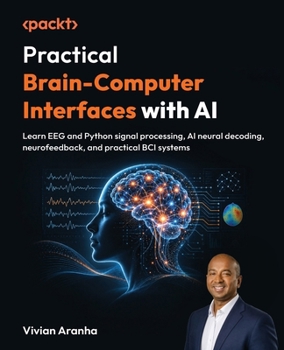
Practical Brain-Computer Interfaces with AI: Learn EEG and Python signal processing, AI neural decoding, neurofeedback, and practical BCI systems

Explore brain-computer interfaces and neurotechnology through EEG, Python, AI, and neural decoding, with applications in wearable BCIs, neurofeedback, assistive systems, human-machine interaction, and responsible design.
Key Features:
- Build BCI and neurotechnology pipelines for EEG acquisition, signal processing, neural decoding, and feedback
- Use Python, OpenBCI, BrainFlow, MNE-Python, and LSL with real or simulated EEG data
- Apply AI and machine learning to neurofeedback, brain-controlled devices, and real-time BCI systems
Book Description:
Brain-computer interfaces (BCIs) and neurotechnology are reshaping how people communicate with machines, restore movement, monitor cognitive states, and control digital or physical systems. Building practical neural interfaces requires an understanding of neuroscience, EEG signal processing, AI, machine learning, real-time feedback, and responsible design.
This book takes you from BCI foundations to implementation. You will explore neuroanatomy, brain rhythms, invasive and non-invasive interfaces, EEG, ECoG, MEG, and fMRI before working through sensors, sampling, filtering, artifact removal, time-frequency analysis, and P300, SSVEP, and ERD/ERS feature extraction. You will then use PCA, ICA, supervised learning, deep learning, transfer learning, and adaptive methods for neural decoding and intent classification.
Using Python, OpenBCI, BrainFlow, MNE-Python, and LSL, you will build real-time BCI pipelines with real or simulated EEG data and apply them to neurofeedback, closed-loop feedback, cognitive-state monitoring, assistive communication, wearable BCIs, robotics, and brain-controlled devices for human-machine interaction. You will also examine neural privacy, neurorights, security, governance, and neuroethics, helping you develop practical neurotechnology systems with a clear view of their technical and societal trade-offs.
What You Will Learn:
- Explain how neural signals and brain regions shape practical BCI design
- Capture and filter EEG signals using sensors, sampling, and noise reduction
- Remove artifacts and extract P300, SSVEP, and ERD/ERS features
- Apply PCA, ICA, machine learning, and deep learning for neural decoding
- Build real-time BCI pipelines with Python, OpenBCI, BrainFlow, MNE-Python, and LSL
- Create neurofeedback and brain-controlled device interfaces
- Evaluate BCI models across users, sessions, latency, and accuracy
- Assess neural privacy, neurorights, security, and neuroethical risks
Who this book is for:
This book is for BCI and neurotechnology engineers, biomedical and signal processing engineers, AI/ML engineers, data scientists, neuroscience and HCI researchers, medical-device developers, robotics engineers, and technical founders building EEG, neurofeedback, assistive, or brain-controlled applications. Readers will progress from neural signal acquisition and processing to machine learning, neural decoding, real-time feedback, and practical BCI prototypes. No prior neuroscience experience is required; basic computer skills are expected, Python is helpful, and EEG hardware is optional.
Table of Contents
- Introducing brain-computer interfaces
- Understanding the neuroscience behind BCIs
- Exploring BCI hardware and signal acquisition
- Processing and analyzing neural signals
- Decoding brain signals with machine learning
- Building closed-loop BCIs and neurofeedback systems
- Applying BCIs in medicine, gaming, and robotics
- Developing BCIs with software tools and frameworks
- Navigating neuroethics and brain data governance
- Building BCI capstone projects
Customer Reviews
ThriftBooks ® and the ThriftBooks ® logo are registered trademarks of Thrift Books Global, LLC
