


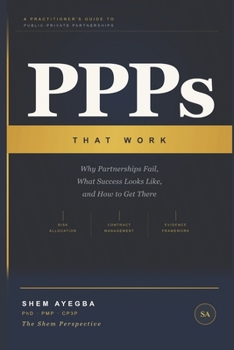
PPPs THAT WORK: A Practitioner's Guide to Public-Private Partnerships

Governments around the world turn to public-private partnerships (PPPs) to deliver infrastructure they cannot build on their own. The logic is simple: combine public authority with private capital and expertise. The outcomes are far less consistent.
This book examines why.
Drawing on doctoral research into housing PPP failures and professional experience across construction, infrastructure, and government in three continents, Shem Ayegba offers a concise, research-grounded guide for practitioners who design, negotiate, and manage PPPs.
At its core is a central paradox: practitioners broadly understand what makes PPPs work, yet the conditions for success are routinely absent. PPP failure, therefore, is not primarily a technical problem. It is an institutional and political one.
The book identifies four systemic drivers of underperformance: fiscal illusion, weak institutional capacity, political capture, and private-sector capability gaps, and shows how they interact to shape outcomes. It then sets out a practical framework for delivery: how to assess readiness before launching a PPP, how to structure contracts that credibly allocate risk, and why long-term contract management, not deal signing-ultimately determines success.
Drawing on real-world examples from Canada, the United Kingdom, Portugal, Hungary, Nigeria, South Africa, the Philippines, and Bolivia, the book connects theory to practice across transport, energy, water, housing, and social infrastructure.
Written for government officials, infrastructure professionals, development finance practitioners, and CP3P candidates.
Grounded in research. Built for delivery.
Customer Reviews
ThriftBooks ® and the ThriftBooks ® logo are registered trademarks of Thrift Books Global, LLC
