


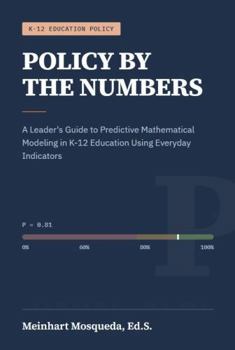
POLICY BY THE NUMBERS:: A Leader’s Guide to Predictive Mathematical Modeling in K-12 Education Using Everyday Indicators

Every district leader already knows which students are struggling. The problem isn't instinct - it's that instinct doesn't scale, and by the time report cards confirm it, the window to act has closed.
Policy by the Numbers hands education leaders a real, working predictive model - built entirely from data districts already collect - that flags at-risk students while there's still time to help them. No data science team required, no black-box software, no jargon you can't repeat to a school board.
The book follows Sagebrush Valley, a composite district, from a three-week data-cleanup sprint to a fully funded, board-approved intervention, then follows that same discipline outward: scaling to an entire state without letting a healthy average hide a struggling school, holding up under a genuine second-year validation check, and surviving contact with federal reporting requirements without losing its original purpose.
At the center of the model is the Support Coefficient - a mechanism that turns "we should help this group of students" into a specific, fundable, measurable target, making equity a quantifiable part of the math rather than an afterthought bolted on. A dedicated chapter makes the case for why this particular approach - plain logistic regression, not a fancier algorithm - is the right tool for a decision this consequential, and a full statistical formalization gives a data team everything it needs to verify the math for themselves.
The book doesn't stop at building the model. It covers what happens when a prediction misses, who's accountable when the model flags a real student, and what a model should never be allowed to decide alone.
Written by an author who has spent a career moving between particle physics research and statewide education policy, Policy by the Numbers is for superintendents, principals, curriculum directors, and state agency staff who want a tool that respects both the rigor of the math and the judgment of the educator making the final call. Diagnostic, not deterministic - this model finds where the system needs to show up. It never decides where a student ends up.
Customer Reviews
ThriftBooks ® and the ThriftBooks ® logo are registered trademarks of Thrift Books Global, LLC
