


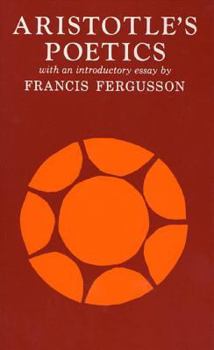
Aristotle's Poetics


Select Format
Select Condition 
Book Overview
Introduced by Francis Fergusson, the Poetics, written in the fourth century B.C., is still an essential study of the art of drama, indeed the most fundamental one we have. It has been used by both playwrights and theorists of many periods, and interpreted, in the course of its two thousand years of life, in various ways. The literature which has accumulated around it is, as Mr. Fergusson points out, "full of disputes so erudite that the nonspecialist can only look on in respectful silence." But the Poetics itself is still with us, in all its suggestiveness, for the modern reader to make use of in his turn and for his own purposes.
Francis Fergusson's lucid, informative, and entertaining Introduction will prove invaluable to anyone who wishes to understand and appreciate the Poetics. Using Sophocles' Oedipus Rex, as Aristotle did, to illustrate his analysis, Mr. Fergusson pints out that Aristotle did not lay down strict rules, as is often thought: "The Poetics," he says, "is much more like a cookbook than it is like a textbook of elementary engineering." Read in this way, it is an essential guide not only to Sophoclean tragedy, but to the work of so modern a playwright as Bertolt Brecht, who considered his own "epic drama" the first non-Aristotelian form.Format:Paperback
Language:English
ISBN:0809005271
ISBN13:9780809005277
Release Date:January 1961
Publisher:Hill & Wang
Length:128 Pages
Weight:0.49 lbs.
Dimensions:0.3" x 4.5" x 7.3"
Customer Reviews
5 ratings
Excellent text for intro to theatre course
Published by Thriftbooks.com User , 18 years ago
This translation uses terminology appropriate for teaching the Poetics to beginning theatre students. It is an excellent version for use in a theatre (as opposed to philosophy) class, and the budget price and slim size of the edition make it a fine bargain for students with limited finances. As a theatre teacher of students from middle school to college, I strongly recommend selecting this particular edition and translation of the Poetics for use in discussing the parts of drama in an introductory course.
Aristotle Clearly Explained
Published by Thriftbooks.com User , 18 years ago
By this time, the importance of Aristotle as a philosopher and the first analyst of drama is well known. For budding screenwriters, reading and understand his Poetics is one of the requirements for building good stories. Since I can't read the original in its Attic Greek, good translations are worth their weight in gold. Malcolm Heath's excellent translation is incredible. First, the introduction to the main work is longer than the translation itself. Heath dissects and explains EVERYTHING so that when reading the main work, things are clear. Not satisfied with that, there are notes to the translation as well! One comes away from this work with a crystal clear understanding of the concepts Aristotle teaches. This definitely is my preferred translation of the Poetics. 10 stars!
Poignant Insights
Published by Thriftbooks.com User , 22 years ago
The ancient observer's insights have stood the test of time. Some elements of human nature remain consistent regardless of the century or technology. Aristotle thought classification was important. In this work he sets forth a taxonomy for poetics. One of the more controversial statements he makes in this book is "poetry is both more philosophical and more serious than history." He doesn't leave it at that, being the philosopher he is he goes on to explain himsself. He adds, "poetry speaks more of what is universally the case, whereas history speaks of particular events." This book will give you a comparison that spans cultures and centuries.
Where art theory began
Published by Thriftbooks.com User , 24 years ago
This book (or perhaps just a portion of Aristotle's lecture notes) remains the acorn of an oak of subjects, from art criticism to playwriting to poetry. This is a clear, accurate translation (it helped me pass a test in Ancient Greek; and people who really know assure me). The text is no-frills and the introduction is brief but informative. This is probably not for scholars who will want to quibble over the meaning of 'phusis' and 'techne' but for the general reader who will be infinitely enriched by a philospical masterwork. Unlike other such masterworks, this one is short and readable!
A Classical masterpiece!
Published by Thriftbooks.com User , 25 years ago
Aristotle's Poetics is hailed as the first systematic critical theory in the world. For centuries and centuries, it has inspired writers, critics, and philosophers alike. Aristotle, the father of critics, as many would exalt him, sets the rules for many key literary genres such as Tragedy, Comedy, and Epic. Through comparing and contrasting these classical genres, Aristotle convincingly argues for the highness and greatness of tragedy, as the most mimetic literary genre. Thanks to Aristotle, we are introduced to such eternally important critical terms such as mimesis(imitation), muthos(plot), anagnorisis(discovery), peripeteia(reversal),hamartia(misjudgment), catharsis(purgation). In other words, Aristotle's Poetics is the bible for critics, playwrights, and fans of tragic literature.
Copyright © 2026 Thriftbooks.com
Terms of Use | Privacy Policy | Do Not Sell/Share My Personal Information | Cookie Policy | Cookie Preferences | Accessibility Statement
ThriftBooks ® and the ThriftBooks ® logo are registered trademarks of Thrift Books Global, LLC
ThriftBooks ® and the ThriftBooks ® logo are registered trademarks of Thrift Books Global, LLC
