


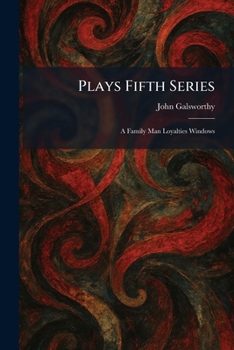
Plays Fifth Series: A Family Man Loyalties Windows

In "Plays Fifth Series: A Family Man Loyalties Windows", Nobel Prize-winning author John Galsworthy presents three compelling dramas that scrutinize the moral and social fabric of early twentieth-century Britain. This collection highlights Galsworthy's mastery of social realism and his keen observation of human nature across different spheres of life.
"A Family Man" delves into the domestic sphere, portraying the friction between traditional patriarchal authority and the burgeoning independence of the younger generation. "Loyalties", perhaps the most acclaimed work in this series, is a tense and provocative study of group identity and prejudice. When a theft occurs at a country house party, the characters' conflicting allegiances to class, race, and profession expose the fragile veneer of polite society. Finally, "Windows" offers a comedy for idealists, following a family's well-intentioned but complicated efforts to rehabilitate a young woman after her prison sentence, raising questions about justice and social responsibility.
Through these works, Galsworthy continues his career-long exploration of the complexities of the British class system and the ethical dilemmas faced by individuals caught within rigid social structures. These plays remain significant for their sharp dialogue, psychological depth, and enduring relevance to themes of integrity and social justice.
This work has been selected by scholars as being culturally important, and is part of the knowledge base of civilization as we know it. This work was reproduced from the original artifact, and remains as true to the original work as possible. Therefore, you may see the original copyright references, library stamps (as most of these works have been housed in our most important libraries around the world), and other notations in the work.
This work is in the public domain in the United States of America, and possibly other nations. Within the United States, you may freely copy and distribute this work, as no entity (individual or corporate) has a copyright on the body of the work.
As a reproduction of a historical artifact, this work may contain missing or blurred pages, poor pictures, errant marks, etc. Scholars believe, and we concur, that this work is important enough to be preserved, reproduced, and made generally available to the public. We appreciate your support of the preservation process, and thank you for being an important part of keeping this knowledge alive and relevant.
Customer Reviews
ThriftBooks ® and the ThriftBooks ® logo are registered trademarks of Thrift Books Global, LLC
