


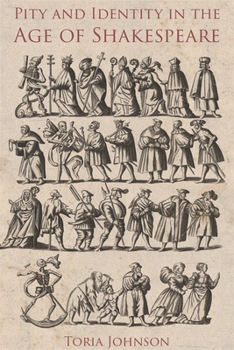
Pity and Identity in the Age of Shakespeare
No Customer Reviews

Early modern English writing about pity evidences a social culture built specifically around emotion, one (at least partially) defined by worries about who deserves compassion and what it might cost an individual to offer it. Pity and Identity in the Age of Shakespeare positions early modern England as a place that sustains messy and contradictory views about pity all at once, bringing together attraction, fear, anxiety, positivity, and condemnation to paint a picture of an emotion that is simultaneously unstable and essential, dangerous and vital, deceptive and seductive. The impact of this emotional burden on individual subjects played a major role in early modern English identity formation, centrally shaping the ways in which people thought about themselves and their communities.
Taking in a wide range of material - including dramatic works by William Shakespeare, Thomas Heywood, Ben Jonson, Thomas Middleton, and William Rowley; medieval morality drama; and lyric poetry by Philip Sidney, Thomas Wyatt, Samuel Daniel, Thomas Lodge, Barnabe Barnes, George Rodney and Frances Howard - this book argues for the central significance of literary material to the broader history of emotions, a field which has thus far remained largely the concern of social and cultural historians. Pity and Identity in the Age of Shakespeare shows that both literary materials and literary criticism can offer new insights into the experience and expression of emotional humanity.
Taking in a wide range of material - including dramatic works by William Shakespeare, Thomas Heywood, Ben Jonson, Thomas Middleton, and William Rowley; medieval morality drama; and lyric poetry by Philip Sidney, Thomas Wyatt, Samuel Daniel, Thomas Lodge, Barnabe Barnes, George Rodney and Frances Howard - this book argues for the central significance of literary material to the broader history of emotions, a field which has thus far remained largely the concern of social and cultural historians. Pity and Identity in the Age of Shakespeare shows that both literary materials and literary criticism can offer new insights into the experience and expression of emotional humanity.
Format:Hardcover
Language:English
ISBN:1843845741
ISBN13:9781843845744
Release Date:November 2021
Publisher:Boydell & Brewer
Length:246 Pages
Weight:0.95 lbs.
Dimensions:0.6" x 5.5" x 8.5"
Customer Reviews
0 rating
Copyright © 2026 Thriftbooks.com Terms of Use
| Privacy Policy | Do Not
Sell/Share My Personal Information | Cookie Policy | Cookie Preferences | Accessibility Statement
ThriftBooks® and the ThriftBooks® logo are registered trademarks of Thrift Books Global, LLC
ThriftBooks® and the ThriftBooks® logo are registered trademarks of Thrift Books Global, LLC
