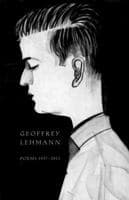
The 128 poems of Picking Nasturtiums - poems mainly in my own voice 1957-2026 is the summation of Geoffrey Lehmann's more personal poems which he thinks readers may enjoy reading.
They stand apart from three other streams of his poetry: Nero's Poems Redux spoken through the extreme voice of the Roman emperor; Spring Forest spoken through the laconic voice of an Australian farmer and shortlisted for the T S Eliot Prize in 1994; and rhymed translations of Rainer Maria Rilke, Fifty Poems, begun when Lehmann was seventy-eight and published by New York Review of Books in 2025.
Lehmann's precocious debut poem "An Image", was published in the London Magazine in 1959 when he was eighteen, and anthologised the following year in The Guinness Book of Poetry 1958/59. In 1965 he shared his first book of poems, The Ilex Tree, with Les Murray. Roy Fuller's review in the London Magazine stated: "Lehmann already seems to me to be a strong and original poet".
His poetry then diverged into its streams, and in 2014 Geoff Page wrote in The Sydney Review of Books: "Geoffrey Lehmann . . . has been the most protean poet of his generation, a user of masks, but also of those difficult tones which allow direct confession without sentimentality or self-deception."
Highlights of Picking Nasturtiums include "An Image", still as it was in 1959, and many early poems with small tweaks. Among these are "The Last Campaign", once a popular anti-war anthology piece, which the poet discarded for many years because of flaws - now fixed - and the final and definitive "Meditations of Marcus Furius Camillus, Governor of Africa". Mainly about dolphins and lions, these "meditations" are what the poet likes best among his poems, as did Roy Fuller, who described them as "a highly rewarding feat of imagination".
Also of note are some new poems. "At Currarong" imagines a young girl finding the dead bodies of thousands of migrating mutton birds on a beach - "the death of a cosmos" - and she resolves to become "the protector of birds". "The Inequality of Sprawl" has a hilarious slant on the events giving rise to Les Murray's famous poem "The Quality of Sprawl". "Anita Russakova Walking to the Gulag" describes Victor Serge's sister-in-law walking through the snow in her blue shoes to a Soviet prison camp.
Written during the COVID pandemic, "The Nature of Things", sees viruses as "the night workers in the supermarket" and welcomes our "many nationalities", our "many sexualities", as "not survival of the fittest", but "survival of the adequate" - "The viruses are us. We are them."