


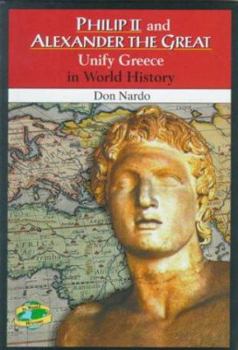
Philip II and Alexander the Great Unify Greece in World History

Famous as the birthplace of Western culture and democratic government, ancient Greece was never a unified nation in a modern sense. Instead, it was divided into many rival city-states, each of which viewed itself as a separate nation. Historian Don Nardo traces King Philip II of Macedonia's crafty, sometimes brutal, and always tireless efforts to bring the city-states under his control in the fourth century B.C. Nardo also explains how, after Philip's untimely death, his son, Alexander the Great, carved out a vast empire of his own and spread Greek culture throughout the Near East, profoundly affecting the development of that region for centuries to come.
Format:Library Binding
Language:English
ISBN:0766013995
ISBN13:9780766013995
Release Date:January 2000
Publisher:Enslow Publishing
Length:112 Pages
Weight:0.90 lbs.
Dimensions:0.5" x 6.3" x 9.3"
Age Range:12 to 17 years
Grade Range:Grades 7 to 12
Related Subjects
Ancient Biographies Children's Children's Books Historical History Literature & FictionCustomer Reviews
4 ratings
A Good Overview of Philip II
Published by Thriftbooks.com User , 24 years ago
This book is the best book I have seen about King Philip II for general readers. Several scholarly books that are available contain more information of course. But for those who want a simple, straightforward overview, this book is excellent. The book contains a good deal less on Alexander and seems to make the case that much of Alexander's later success was due to his father's considerable talents. Nice job all around.
A Very Informative Volume
Published by Thriftbooks.com User , 24 years ago
The achivements and conquests of the Macedonian king Philip II are summarized in this highly informative volume. The author devotes most of the book to Philip, rather than his illustrius son, Alexander, which is Ok because there are plenty of books about Alexander out there already. It is really refreshing to find out how much of Alexnader's accomplishments were the result of his father's talent and achievements, which tend to get glossed over in a lot of books about Alexander. As one of the reviews above mentions, the author does a really nice job of working in actual quotes from ancient writers, which gives the book a strong feeling of authenticity.
A Highly Informative Book
Published by Thriftbooks.com User , 25 years ago
Don Nardo, the leading classical historian in the U.S. young adult market, has turned out yet another fine piece of historical writing. Here, he approaches an often-done subject from a fresh viewpoint. Instead of focusing most of the time on Alexander and mentioning his father Philip in a mere few pages, as so many books of this kind tend to do, Nardo focuses most of the book on Philip and how in an amazingly short span of time he forged a nation out of petty competing factions in a Macedonia that was viewed by Athens and other leading Greek city-states at that time as a backward, uncultured place, and also how he created a formidable army, one that Alexander later used to conquer Persia with. I have read just about all of the important literature in this subject area, and Nardo's is the only non-scholarly study I know of that goes into Philip's life and exploits in such detail. The title of the book is a bit misleading, in that it could be construed by those who have not read the book to mean that the unity Philip and Alexander brought to Greece was complete and/or permanent; and I suspect that this was not Nardo's own title, but rather one imposed by the publisher. However, throughout the book, Nardo makes it very clear that said unity was only partial (Sparta and some other Greek states not taking part), impermanent, and also achieved by brute force, since the Macedonians marched into southern Greece and imposed their will on the residents. This is excellent, well-informed historical writing, of far better quality than some scholarly books I have seen, although admittedly couched in simple terms and language for its young audience.
Excellent Work
Published by Thriftbooks.com User , 25 years ago
There is no bigger crime one can commit against history and human-kind in general, especially the younger generations, than distorting history itself. The undisputed fact is that the "Greeks" or "Hellenes", as is more correct, are made up of a mosaic of different peoples with common characteristics. The Macedonians, just like the Spartans, Athenians, Corinthians, and the citizens of Argos, Thebes, Phokis, Eretria and dozens of other regions, spoke and wrote the Greek language, had Greek names, believed in the Greek gods, used Greek architecture and most of all considered THEMSELVES to be Greek, thus setting themselves apart from all others whom they viewed as "Barbarians";. The book in question deals successfully with the unification of Greece that took place under the hegemony of Macedonia and lead to the downfall of the Persian empire and the establishment of the mighty Empire of Alexander the Great, through which the Greeks avenged themselves for the Persian Wars and spread Hellenism across the "Known World" and into the far reaches of uncharted lands in Asia.
Copyright © 2026 Thriftbooks.com Terms of Use
| Privacy Policy | Do Not
Sell/Share My Personal Information | Cookie Policy | Cookie Preferences | Accessibility Statement
ThriftBooks® and the ThriftBooks® logo are registered trademarks of Thrift Books Global, LLC
ThriftBooks® and the ThriftBooks® logo are registered trademarks of Thrift Books Global, LLC
