


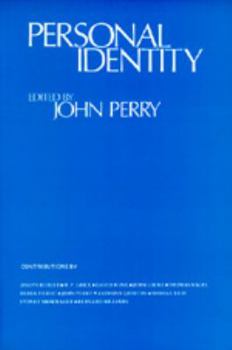
Personal Identity (Topics in Philosophy)


Select Format
Select Condition 
Book Overview
This volume brings together the vital contributions of distinguished past and contemporary philosophers to the important topic of personal identity. The first part sets forth the attempts by John Locke, Anthony Quinton, and H. P. Grice to analyze personal identity in terms of memory. The eleven other selections are largely critical of this approach and provide alternative perspectives.
Part II contains classic contributions by Joseph Butler, Thomas Reid, and Sydney S. Shoemaker, and a new paper by John Perry--"Personal Identity, Memory, and the Problem of Circularity"--in which he defends some of the central features of the Locke-Grice-Quinton approach.
Part III contains three sections from David Hume's Treatise of Human Nature: "Our idea of Identity," "Of Personal Identity," and an appendix which the editor has entitled "Second Thoughts."
In the fourth part of the volume, Bernard Williams discusses "The Self and the Future," and Derek Parfit contributes his view of "Personal Identity."
A recurring theme throughout the work is the possibility of "body transfer"--of a single person having, at different times, different bodies. In the final section of the volume ("Brian Bisection and the Unity of Consciousness"), Thomas Nagel examines the philosophical implications of recent scientific research on split-brain patients' he discusses the possibility, entertained by some researchers, that such cases involve two persons simultaneously inhabiting a single body.
In his long introduction to this unique anthology on a topic of prime interest to the philosophical community, Mr. Perry scrutinizes the differing approaches and vocabularies of the various authors. The editor also includes "Suggestions for Further Reading."
Part II contains classic contributions by Joseph Butler, Thomas Reid, and Sydney S. Shoemaker, and a new paper by John Perry--"Personal Identity, Memory, and the Problem of Circularity"--in which he defends some of the central features of the Locke-Grice-Quinton approach.
Part III contains three sections from David Hume's Treatise of Human Nature: "Our idea of Identity," "Of Personal Identity," and an appendix which the editor has entitled "Second Thoughts."
In the fourth part of the volume, Bernard Williams discusses "The Self and the Future," and Derek Parfit contributes his view of "Personal Identity."
A recurring theme throughout the work is the possibility of "body transfer"--of a single person having, at different times, different bodies. In the final section of the volume ("Brian Bisection and the Unity of Consciousness"), Thomas Nagel examines the philosophical implications of recent scientific research on split-brain patients' he discusses the possibility, entertained by some researchers, that such cases involve two persons simultaneously inhabiting a single body.
In his long introduction to this unique anthology on a topic of prime interest to the philosophical community, Mr. Perry scrutinizes the differing approaches and vocabularies of the various authors. The editor also includes "Suggestions for Further Reading."
Format:Paperback
Language:English
ISBN:0520029607
ISBN13:9780520029606
Release Date:June 1975
Publisher:University of California Press
Length:246 Pages
Weight:0.11 lbs.
Dimensions:8.3" x 0.8" x 5.5"
Customer Reviews
2 ratings
A Nice, Albeit Somewhat Outdated, Anthology
Published by Thriftbooks.com User , 22 years ago
This is a first-rate anthology on personal identity that includes important historical work and recent (up to the 70s) discussions of the relevant issues. It begins with an informative introduction by Perry. The introduction presents the basic problem and the way philosophers traditionally have thought about it. Then Perry gives a summary of most important points made in the historical material included in the anthology. What is the question of personal identity? Basically, it's the question of what makes a person one and the same person through time. I assume I'm very same person I was two days ago, two months ago, two years ago, two decades ago, etc. Given that I've changed a great deal over that period of time, how could this be? It seems like I, the very person sitting here and typing this now, was once an undergraduate planning to go to grad school, once a high school student getting ready for college, once a elementary school kid, and once a newborn baby. But it's clear that I don't look or think a lot like those previous people who appear to be one and the same as I am. There's been a lot of physical and psychological change over time, and yet I think I'm the very same person I was at those various times. How could that be?And this is a philosophical issue that seems to have practical ramifications. It appears to have consequences for how we understand ourselves and other people: Does a person survive radical amnesia? How about brain death? Could a person survive after bodily death? Could there be multiple people in the same body at the same time? If a person's memories, beliefs, desires, etc. change so that there's little or no connection to her previous self, is she really the same person at all anymore? Consequences for how we relate to people: If my friend suffers from amnesia and never recovers his prior memories, is he really still my friend (is he still the same person I knew before)? If my mother is dying from a disease that has left her little more than a body rotting away in a hospital bed, is she still really my mother (i.e. the same person who raised me)? And moral consequences: Is a fetus a person? If a person's psychology has radically changed over time, is it still fair to hold her responsible for things she did long ago (maybe she's no longer the person who did whatever we want to hold her responsible for)? Now, clearly, it's pointless to try to summarize even the most important ideas that you'll find in the readings collected here. There are too many positions, too many important arguments, and too many interesting issues to say much of importance about the anthology as a whole. But I will try to give you some sense of the contents here.The first reading is from the seminal work on this topic, namely Locke's discussion in his Essay concerning Human Understanding. In a few justly famous thought experiments, Locke argues against the view that personal identity consists in identity of immaterial s
Personal Identity, ed. John Perry
Published by Thriftbooks.com User , 26 years ago
This is a terrific collection of works on problems concerning personal identity (what are the criteria for personal identity? is personal identity presupposed by the criterion of memory? does personal identity matter?) including both historical pieces (Locke, Hume, Butler, Reid) and contemporary ones (Grice, Williams, Perry, Parfit.) It's a great introduction to the issues, but an introduction you'll not want to leave behind.
Copyright © 2026 Thriftbooks.com
Terms of Use | Privacy Policy | Do Not Sell/Share My Personal Information | Cookie Policy | Cookie Preferences | Accessibility Statement
ThriftBooks ® and the ThriftBooks ® logo are registered trademarks of Thrift Books Global, LLC
ThriftBooks ® and the ThriftBooks ® logo are registered trademarks of Thrift Books Global, LLC
