


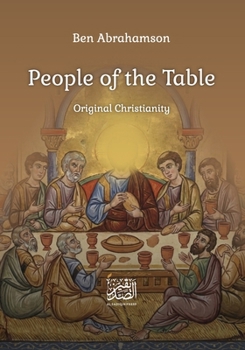
People of the Table: Original Christianity

People of the Table is a strikingly original and intellectually ambitious work that reopens a conversation long ignored in Western scholarship: the possibility that the Qur'an preserves memories of a halakhic, Temple-centered Jesus movement older than the traditions that later solidified into Rabbinic Judaism and Gentile Christianity. The author brings together biblical studies, classical tafsīr, Jewish halakhah, Second Temple history, and the sociology of early Christian communities in order to propose a unified explanatory model for the most puzzling Qur'anic statements about Jesus and his followers.
Rather than interpreting Qur'anic narratives as polemics or theological inventions, the book consistently asks: What if these passages reflect genuine memories of early Jewish-Christian practice-preserved not in the Mediterranean Church, but in the oral and communal traditions that survived in Arabia? This single question becomes the key that unlocks an impressive range of phenomena: the "People of the Table," Jesus' vow-like abstentions, Nazarite features, the inclusion of marginalized Idumeans, the Galilee-Judea tension, Paul's vocabulary of grace and offering, and the Qur'an's depiction of the disciples as loyal covenant-keepers.
One of the book's most innovative contributions is its halakhic framing of Jesus' ministry. Instead of reading Jesus as a critic of Judaism or a founder of a rival religion, the author reconstructs Jesus as a Nazarite vow-taker whose movement used the established mechanisms of the Temple-especially Arakhin vows and completion meals-to bring "invalid Jews," God-fearers, and Gentiles into lawful relationship with Israel's God. This reframing allows the Qur'anic story of the heavenly table to be read not as a foreign miracle but as a memory of an actual ritual: the Nazarite completion banquet, with all its covenantal, communal, and sacrificial significance.
Equally impressive is the treatment of the Edomites. The author argues that the forcibly Judaized Idumeans-marginalized yet covenantally attached-formed the earliest nucleus of Jesus' mission. This bold proposal is grounded in demographic migration, Herodian politics, and the symbolic reading of Psalm 118's "rejected stone," tying together biblical motifs that are rarely brought into conversation.
The book also offers a fresh perspective on Paul, whose letters are interpreted not as breaks from Judaism but as expansions of Nazarite-Arakhin logic for the nations. The section on textual culture is particularly valuable: it explains why the New Testament exhibits manuscript variation while the Torah and Qur'an do not, arguing persuasively that Greek paraphrase functions analogously to midrash or ahadith-capturing authorized shades of meaning rather than producing contradictions.
If the book has a challenge, it is that its thesis-deeply integrative and unconventional-will require readers to rethink familiar categories. But that is precisely its strength. People of the Table invites scholars, clergy, and lay readers alike to reconsider long-held assumptions about the early Jesus movement, the Qur'an's historical memory, and the interwoven destinies of the Children of Israel and the nations. It offers neither apology nor syncretism, but a robust reconstruction grounded in halakhic reasoning, historical plausibility, and textual coherence across traditions.
In a time when religious discourse often divides, this book accomplishes something rare: it presents a vision of Judaism, Christianity, and Islam as distinct yet mutually illuminating participants in a shared covenantal architecture. Its closing emphasis on "spiritual commerce" and a "race for virtue" is not merely poetic-it is a compelling ethical model anchored in ancient tradition and urgently relevant today. It deserves a wide readership and will undoubtedly inspire further scholarship in this newly opened field.
Customer Reviews
ThriftBooks ® and the ThriftBooks ® logo are registered trademarks of Thrift Books Global, LLC
