


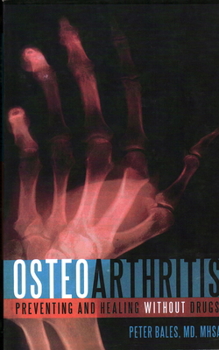
Osteoarthritis: Preventing and Healing Without Drugs


Select Format
Select Condition 
Book Overview
Osteoarthritis affects over 20 million Americans and is the most common degenerative disorder in the United States. It causes more disability than any other degenerative disease and is occurring in epidemic proportions in our country.In this novel approach to understanding and treating osteoarthritis, orthopedic surgeon Peter Bales highlights the nutritional connection to this painful and debilitating condition. Dr. Bales focuses on new genetic research, which shows that the same poor nutrition responsible for causing increased inflammation in our bodies, along with epidemic rates of obesity, diabetes, and heart disease, is also fueling the development of osteoarthritis. Among the topics discussed are the following: *The mechanisms by which our joints become destroyed. The culprits are increased inflammation, increased oxygen free radicals causing our joints to "rust" from chronically elevated blood sugar levels, and hormonal imbalance.*Dietary strategies to decrease the production of oxygen free radicals and to turn off genes that lead to cartilage breakdown.*Joint nutrients that can combat osteoarthritis and specific dietary recommendations for the treatment and reversal of osteoarthritis based on the most current genetic and nutritional research.*The disadvantages of treating osteoarthritis with drugs and the exciting promise of using nutritional intervention that directly affects the expression of our genes.The only book to emphasize the link between poor nutrition and this often-disabling disease, Osteoarthritis: Preventing and Healing without Drugs offers hope for arthritis sufferers and will be of interest to anyone concerned about good health.
Format:Paperback
Language:English
ISBN:1591026156
ISBN13:9781591026150
Release Date:September 2008
Publisher:Prometheus Books
Length:284 Pages
Weight:0.90 lbs.
Dimensions:0.5" x 6.1" x 8.9"
Customer Reviews
2 ratings
more evidence that our nation's food habits are wrong
Published by Thriftbooks.com User , 16 years ago
Osteoarthritis is one of those disorders which, like hypertension, you don't notice until a lot of damage has already been done. So for many this book will come too late. The word healing appears in the title so maybe in cases that are not too far advanced it is possible to arrest and/or reverse the damage. As I read the chapter on metabolic syndrome, I got to thinking that symptoms associated with it: 1. increased abdominal fat 2. increased blood fat -- triglycerides greater than 150 mg/dl 3. decreased HDL 4. increased blood pressure 5. increased fasting blood sugar -- greater than 110 mg/dl may be too high to warn of impending arthritis. Instead, it might be better to tighten those readings and use them as alarms that go off when they even approach the high end of "normal". For abdominal fat, for instance, getting down to one half inch or less should be the goal rather than below forty-inch waistline. Bales doesn't say that, but I just did. Bales is a physician and maybe it would be difficult for him to go against the establishment by recommending revisions to the "normal" readings. I'm thinking earlier warnings are better than waiting for the pain when severe damage has already been done. What Bales tries to show is how diet and some supplements can prevent osteoarthritis. Many of his recommendations are similar to those of author Joel Fuhrman, author of Eat to Live. But, the word osteoarthritis does not even appear in the index of Eat to Live and Bales goes into depth about how a bad diet actually causes reactions in the body that lead to destruction of cartilage. It is this detail that makes his case so convincing. He presents it, as much as possible, in a fashion that should be understandable by the layman. If more detail is desired, one can look up the terms he uses on the internet for a much more scholarly discussion. Bales recommends 20 supplements. I would research them more. For glucosamine and chondroitin, for instance one recent study indicates that each by itself is effective, but taking them simultaneously seems to have no effect. Also, with fish oils which Bales recommends, Joel Fuhrman says in Eat to Live page 171 "Though a little more expensive than fish oil, plant-derived DHA is less rancid. High-dose fish oils are still much safer than the medications used for autoimmune illnesses, so if they help I would not discourage their use." In general, I like to see multiple sources for information regarding health issues -- the second opinion if you will. So researching each supplement would be in order for me. By the end of the book when he summarizes his dietary and supplement recommendations he has made it abundantly clear that the increase in the incidence of osteoarthritis is mostly due to bad eating habits and an irresponsible food industry. Recently I saw the movie Food, Inc. which shows how the food industry creates a bad diet and then convinces us to eat it. My current reading also includes Foods to Fight Cancer by Rich
Health collections will find this a wonderful guide
Published by Thriftbooks.com User , 17 years ago
Peter Bales, MD, MHSA's OSTEOARTHRITIS: PREVENTING AND HEALING WITHOUT DRUGS discusses everything from how joints become destroyed to how nutrients can combat osteoarthritis. Dietary recommendations accompany surveys of drugs, surgeries, and how nutritional intervention affects genes. Health collections will find this a wonderful guide.
Copyright © 2026 Thriftbooks.com
Terms of Use | Privacy Policy | Do Not Sell/Share My Personal Information | Cookie Policy | Cookie Preferences | Accessibility Statement
ThriftBooks ® and the ThriftBooks ® logo are registered trademarks of Thrift Books Global, LLC
ThriftBooks ® and the ThriftBooks ® logo are registered trademarks of Thrift Books Global, LLC
