


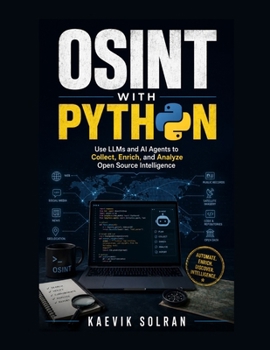
OSINT with Python: Use LLMs and AI Agents to Collect, Enrich, and Analyze Open Source Intelligence
No Customer Reviews

Eleven browser tabs, three terminal windows, and a spreadsheet that never quite stays organized - that is what most OSINT work looks like before automation. This book replaces that workflow with a working Python system: an LLM-powered intelligence pipeline that collects from the web, APIs, social platforms, and network infrastructure, then enriches, verifies, and reports what it finds. You will build the ARIA Pipeline (Automated Reconnaissance and Intelligence Analysis) from the first line of code to a containerized production deployment, using Python, LangChain, CrewAI, the Anthropic and OpenAI SDKs, ChromaDB, and the standard OSINT toolkit (Shodan, theHarvester, Sherlock, Maigret, SpiderFoot). Unlike books that treat AI as a chatbot bolted onto existing scripts, this one treats LLMs as a reasoning layer with mandatory citation verification - every finding in every report traces back to a specific source record. - Build a unified collector schema that normalizes data from web scrapers, APIs, social platforms, and network tools
- Write five-element prompts that produce structured, citation-anchored intelligence extraction
- Build a working LangChain agent that runs OSINT tools autonomously through a ReAct control loop
- Design a three-specialist multi-agent system with enforced data-flow boundaries between Collector, Enricher, and Analyst
- Implement confidence scoring and cross-source deduplication for enriched intelligence records
- Generate automated reports in Markdown, PDF, and STIX 2.1 formats with human review checkpoints
- Build a three-tier agent memory architecture with confidence decay for stale findings
- Construct a RAG knowledge base that compounds verified intelligence across investigations
- Deploy a real-time monitoring system with diff analysis and multi-channel alerting
- Containerize and deploy the complete pipeline with circuit breakers and production error handling Each chapter follows the same approach: a real-world case study showing the pattern in production use, the working Python code with full explanations, common failure modes and their fixes, and a hands-on exercise to verify your build. The legal and ethical chapter is not an afterthought - it covers CFAA, GDPR, and operational security as engineering constraints embedded directly into the pipeline's configuration, not as a disclaimer appended at the end. This book is for intermediate Python developers, security analysts, and threat intelligence practitioners who want to move beyond manual tool-chaining toward a system that runs, remembers, and improves with every investigation. Stop copy-pasting between terminals. Build the pipeline that does it for you.
- Write five-element prompts that produce structured, citation-anchored intelligence extraction
- Build a working LangChain agent that runs OSINT tools autonomously through a ReAct control loop
- Design a three-specialist multi-agent system with enforced data-flow boundaries between Collector, Enricher, and Analyst
- Implement confidence scoring and cross-source deduplication for enriched intelligence records
- Generate automated reports in Markdown, PDF, and STIX 2.1 formats with human review checkpoints
- Build a three-tier agent memory architecture with confidence decay for stale findings
- Construct a RAG knowledge base that compounds verified intelligence across investigations
- Deploy a real-time monitoring system with diff analysis and multi-channel alerting
- Containerize and deploy the complete pipeline with circuit breakers and production error handling Each chapter follows the same approach: a real-world case study showing the pattern in production use, the working Python code with full explanations, common failure modes and their fixes, and a hands-on exercise to verify your build. The legal and ethical chapter is not an afterthought - it covers CFAA, GDPR, and operational security as engineering constraints embedded directly into the pipeline's configuration, not as a disclaimer appended at the end. This book is for intermediate Python developers, security analysts, and threat intelligence practitioners who want to move beyond manual tool-chaining toward a system that runs, remembers, and improves with every investigation. Stop copy-pasting between terminals. Build the pipeline that does it for you.
Format:Paperback
Language:English
ISBN:B0H7WF4YG6
ISBN13:9798185977149
Release Date:July 2026
Publisher:Independently Published
Length:350 Pages
Weight:1.79 lbs.
Dimensions:0.7" x 8.5" x 11.0"
Customer Reviews
0 rating
Copyright © 2026 Thriftbooks.com
Terms of Use | Privacy Policy | Do Not Sell/Share My Personal Information | Cookie Policy | Cookie Preferences | Accessibility Statement
ThriftBooks ® and the ThriftBooks ® logo are registered trademarks of Thrift Books Global, LLC
ThriftBooks ® and the ThriftBooks ® logo are registered trademarks of Thrift Books Global, LLC
