


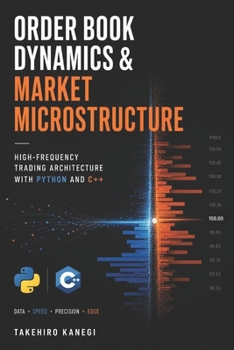
Order Book Dynamics & Market Microstructure: High-Frequency Trading Architecture with Python and C++

Order books sit at the heart of modern electronic markets. Understanding how they form, evolve, and interact with trading strategies is essential for anyone building or analyzing high-frequency systems.
Order Book Dynamics & Market Microstructure: High-Frequency Trading Architecture with Python and C++ provides a practical, engineering-focused examination of the structures and mechanisms that drive short-term price formation. The book moves from core market-microstructure concepts to the design and implementation of low-latency trading architecture.
Readers will explore:
How limit order books operate and the dynamics that emerge from continuous matchingKey microstructure phenomena relevant to high-frequency tradingArchitectural patterns used in production HFT systemsPractical implementations in both Python (for research, simulation, and analysis) and C++ (for performance-critical components)The material emphasizes clarity and technical accuracy over hype. Code examples and system-design discussions are grounded in real market mechanics rather than simplified abstractions.
This book is intended for quantitative developers, software engineers working in electronic trading, and researchers who want a concrete understanding of order-book behavior and the systems built around it. It assumes familiarity with programming and basic market concepts, but does not require prior high-frequency trading experience.
Whether you are building research tools, evaluating execution strategies, or designing latency-sensitive components, the book offers a structured path from market mechanics to working architecture.
Customer Reviews
ThriftBooks ® and the ThriftBooks ® logo are registered trademarks of Thrift Books Global, LLC
