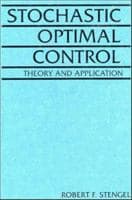
"An excellent introduction to optimal control and estimation theory and its relationship with LQG design. . . . invaluable as a reference for those already familiar with the subject." -- Automatica.This highly regarded graduate-level text provides a comprehensive introduction to optimal control theory for stochastic systems, emphasizing application of its basic concepts to real problems. The first two chapters introduce optimal control and review the mathematics of control and estimation. Chapter 3 addresses optimal control of systems that may be nonlinear and time-varying, but whose inputs and parameters are known without error.Chapter 4 of the book presents methods for estimating the dynamic states of a system that is driven by uncertain forces and is observed with random measurement error. Chapter 5 discusses the general problem of stochastic optimal control, and the concluding chapter covers linear time-invariant systems.Robert F. Stengel is Professor of Mechanical and Aerospace Engineering at Princeton University, where he directs the Topical Program on Robotics and Intelligent Systems and the Laboratory for Control and Automation. He was a principal designer of the Project Apollo Lunar Module control system."An excellent teaching book with many examples and worked problems which would be ideal for self-study or for use in the classroom. . . . The book also has a practical orientation and would be of considerable use to people applying these techniques in practice." -- Short Book Reviews, Publication of the International Statistical Institute."An excellent book which guides the reader through most of the important concepts and techniques. . . . A useful book for students (and their teachers) and for those practicing engineers who require a comprehensive reference to the subject." -- Library Reviews, The Royal Aeronautical Society.
This is an excellent and very comprehensive book. I used it primarily to learn about state estimation. I had already taken courses on estimation, but this book was superior to the texts we used in class. It addresses many practical issues that are left out in the other textbooks that I've seen. Issues like how to determine the discrete-time process noise covariance given continuous dynamics and continuous time process noise covariance are covered by Stengel.
0
★★★★★
Optimal Control and Estimation
By Thriftbooks.com User, February 16, 2008
A great Mathematical Derivation of Least Squares to Weighted Least Squares and then the derivation of the Kalman Filter. Great for Undergraduate mathematicians and electrical engineers.
0
★★★★★
Good book on nonlinear control for the budget conscious
By Thriftbooks.com User, January 19, 2008
"Fundamentals of Kalman Filtering" by Zarchan is a good book on the subject, but with a cost that exceeds one hundred dollars, this is a real stretch on the budget of college students who are just looking for some help. This book is a great one for people interested in nonlinear controls and the Kalman filter at a budget cost. The book introduces stochastic optimal control concepts for application to actual problems with sufficient theoretical background to justify their use, but not enough to get bogged down in the math. The book gives the reader with little background in control theory the tools to design practical control systems and the confidence to tackle more advanced literature - something that both the professional who is a little rusty and the student can appreciate. The reader should have mathematical maturity on the level of second year calculus. The first chapter introduces the reader to the concept of optimal control. Chapter two provides a review of the mathematics of control and estimation. For the seasoned reader, you can proceed directly to chapter three with no real loss. Chapter 3 address optimal control of systems that may be nonlinear and time-varying but whose inputs and parameters are known. It illustrates how open-loop control policies generalize to closed-loop control laws when system dynamics are linear and the cost function is quadratic. Chapter 4 presents methods for estimating the dynamics states of a system that is driven by uncertain forces and is observed with random measurement error. Here is where the excellent discussion of the Kalman filter is located. Chapter 5 discusses the general problem of stochastic optimal control where optimal control depends on optimal estimation of feedback information. Chapter six focuses on linear time-invarient systems for which multivariable controllers can be based on linear-quadratic control laws with linear-Gaussian estimators. The book's examples and problems are directed at confidence building, and thus most of them are rather simple and have the purpose of illustrating concepts, not getting bogged down in mathematics. There are also numerous worked out numerical examples, which is a welcome pleasure in such books that are often very theoretical. Highly recommended.
0
★★★★★
You can find stuff here you can find nowhere else.
By Thriftbooks.com User, September 11, 2003
This book has been less influential on me than some others but nontheless I use it to find information on material that is almost impossible to find elsewhere in any kind of reasonable time. A broad range of topics is covered, not just optimal control. This has been particularly useful in understanding some the actual designs I have been asked to analyze.