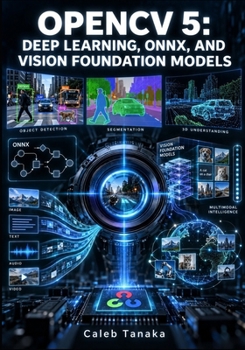
Opencv 5: DEEP LEARNING, ONNX, AND VISION FOUNDATION MODELS: Build Inference Pipelines with the Graph Based DNN Engine, Deploy YOLO and SAM, and Integ

Build modern computer vision and multimodal AI systems with OpenCV 5, from ONNX inference and YOLO deployment to SAM segmentation, vision foundation models, transformers, and LLM integration.
Deploying today's AI models takes more than loading a network and calling inference. You need to understand model graphs, preprocessing contracts, tensor shapes, output decoding, hardware backends, quantization, dynamic inputs, and the boundaries between stable runtime features and rapidly evolving model architectures.
This practical guide shows you how OpenCV 5 fits into the modern AI inference stack. You will learn how to move from validated ONNX models to complete vision pipelines, combine specialized models into larger systems, diagnose failures, measure performance, and design reproducible production deployments.
Understand the graph based DNN engine, tensors, dynamic shapes, operator fusion, backends, targets, and execution flowInspect, validate, export, and debug ONNX models while checking numerical parity across inference runtimesBuild complete YOLO pipelines for detection, segmentation, pose estimation, rotated boxes, video, batching, and trackingDeploy EfficientSAM and original SAM workflows with point, box, foreground, and background prompts and reusable image embeddingsUse DINO and SigLIP embeddings for similarity search, semantic retrieval, and cross modal matchingWork with OWLv2 and Grounding DINO for open vocabulary detection and Depth Anything for dense depth predictionUnderstand transformer attention, tokenization, autoregressive decoding, temperature, top k, top p, and KV cache generationConnect visual encoders with language decoders and understand PaliGemma style multimodal inference and prompt formattingPass detection, segmentation, OCR, tracking, depth, and measurement results into language models as structured evidenceDesign retrieval to VLM and vision to LLM pipelines that combine deterministic computer vision with generative AIBenchmark cold start, warm latency, throughput, tail latency, memory use, and end to end inference costCompare native OpenCV inference, integrated and standalone ONNX Runtime paths, CPU threading, CUDA, OpenVINO, and device transfersApply FP16, BF16, INT8, QDQ, static and dynamic quantization, and low bit weight compression with accuracy validationBuild production releases with model hashes, deployment contracts, golden tests, profiling, fallback handling, licensing awareness, and reproducible configurationsThe book is code heavy, with practical Python examples that take you from tensor preparation and model execution through postprocessing, benchmarking, tracking, retrieval, multimodal integration, and production validation so you can adapt the techniques to real projects.
Rather than treating each AI model as an isolated demo, you will see how the pieces connect: YOLO boxes can guide SAM masks, masks can become measurable OpenCV contours, embeddings can retrieve candidates before VLM analysis, and structured vision results can give LLMs a clearer factual basis for generated responses.
Grab your copy today and start building reliable OpenCV 5 inference pipelines for modern vision and multimodal AI.
Customer Reviews
ThriftBooks ® and the ThriftBooks ® logo are registered trademarks of Thrift Books Global, LLC