


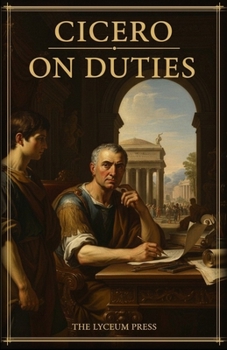
On Duties: De Officiis

The last book Cicero wrote. He was dead within the year, and he knew it was coming.
It is the autumn of 44 BC. Caesar has been stabbed to death in March. The men who killed him had no plan for the morning after. Mark Antony is gathering the pieces. And Cicero - sixty-two years old, out of office, moving between country houses - is writing at a pace that reads like a man running out of time. Fourteen months later he was hunted down on the road and killed, and his head and hands were nailed up in the Roman forum.
What he chose to write, in that season, was a letter to his son about how to be a decent person.
Marcus was twenty-one and in Athens, studying philosophy and, by every account, drinking. That gives this book its strange doubled voice. It is a treatise on moral obligation, and it is also a father who cannot be in the room. Cicero recommends his own speeches. He mentions, more than once, that he did rather well himself. He says he wishes he could be there.
Then he gets to the hard part.
A merchant sails into a starving island with a hold full of grain, and he alone knows that more ships are close behind. Does he have to say so? A man sells a house he knows is falling down, with snakes in the bedrooms. Two shipwrecked men, one plank. A son discovers his father is plotting treason. Someone offers you a fortune to make a fool of yourself in public. And the oldest question of all, put as a shepherd who finds a ring that makes him invisible: if nobody would ever know, would you?
Behind every one of them sits a single claim, repeated until it becomes a refrain - that nothing dishonourable is ever genuinely advantageous, and that the sense of a conflict between the right thing and the profitable thing is always a failure of arithmetic.
Cicero knows this is a hard sell. He also has someone in mind. The man who took everything and was killed for it had been dead seven months, and Caesar is never far from these pages. The book is moral philosophy and it is also, quite openly, an argument that what Caesar did could not possibly have paid.
What this edition is
An original modern rendering in clear English prose. It is not a word-for-word translation from the Latin and does not pretend to be one. Cicero's argument, its order, his examples, his authorities and his conclusions are all here and unaltered; the English carrying them is new, written to be read rather than construed.
All three books are complete, with the traditional chapter divisions preserved, including the third - the part Cicero's Greek source never wrote, and the part where the book comes alive.
This edition includes:
The complete work - all three books, all 103 chapters, in the original orderA foreword on the circumstances of its writing and why the third book is the one that mattersA note on the text, stating plainly what this edition is and how it was madeA biographical essay on Cicero - the ambition, the vanity, the courage, and the endA glossary of Cicero's key terms, for readers who want to see the jointsWhy read it
Because for eighteen centuries this was simply what an educated person had read. Ambrose rewrote it for the Church. It was among the first classical works ever printed with movable type, at Mainz in 1465. Frederick the Great is said to have called it the best book on morals ever written or likely to be.
And because Cicero does not hand down rules. He works through cases, admits when an answer will not come out clean, disagrees with his own authorities, and occasionally leaves a question standing. Some of his assumptions belong to his world and not to ours, and they have not been softened here. But read as training in judgement rather than as a code, it is very nearly as useful now as it was to a young man in Athens who was almost certainly not reading it carefully enough.
Customer Reviews
ThriftBooks ® and the ThriftBooks ® logo are registered trademarks of Thrift Books Global, LLC
