


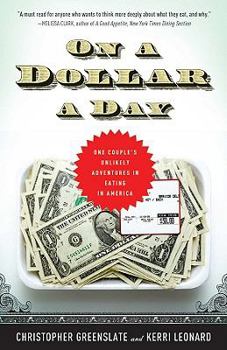
On a Dollar a Day: One Couple's Unlikely Adventures in Eating in America


What happens when two high school teachers get fed up with their soaring grocery bills and decide to try to feed themselves on one dollar each, per day? Authors Kerri Leonard and Christopher Greenslate describe how they did it -- and also include sections about eating on a little more than $4 a day, as well as on the actual costs of eating a healthy diet.On a Dollar a Day also includes fascinating facts about the way our food gets to the table and the hidden costs--both personal and financial -- along the way: How food companies "short size" packages so that you pay more for less food? Why one tablespoon of salad dressing costs as much as a whole orange? How grocery stores auction off foods past their "sell by" dates? Why processed foods have a higher markup than fresh foods? Why it takes so long for food prices to drop, even after fuel and shipping costs go down? How 36 million Americans have limited food options, even during a national obesity epidemic?
Format:Paperback
Language:English
ISBN:1401310184
ISBN13:9781401310189
Release Date:February 2010
Publisher:Hyperion
Length:224 Pages
Weight:0.45 lbs.
Dimensions:8.0" x 5.2"
Age Range:18 years and up
Grade Range:Postsecondary and higher
Customer Reviews
5 ratings
Insights on food politics
Published by Thriftbooks.com User , 16 years ago
ON A DOLLAR A DAY: COUPLE'S UNLIKELY ADVENTURES IN EATING IN AMERICA explores what happens when two high school teachers get fed up with giant grocery bills and decide to feed themselves on one dollar each per day. Their discoveries include tips on how to eat on, $4.13 a day (the food stamp allotment) and offer insights on food politics, from how companies 'short size' packages so you pay more for less, and how groceries auction off foods past their 'sell by' dates.
WOULD YOU BE WILLING TO RADICALLY REDUCE YOUR FOOD BUDGET?
Published by Thriftbooks.com User , 16 years ago
The 2 authors embarked upon 3 monthlong food projects- to eat on $1.00 a day day per person, to eat on the typical food stamp allottment, and with no budget constraints, attempt to eat a healthier diet. The authors educate themselves on the business and politics of food as well as nutrition, and attempt to live their convictions on a budget. Some may consider this book gimmicky, as they did not HAVE to eat with budgetary constraints, but these experiments did lead them to make changes in their attitudes and habits and few of us would be willing to try this ourselves. A lot of the concepts covered in this book are not new, but the authors do put their own stamp on topics covered in other books like "The Omnivores Dilemma" and "Plenty". The authors alternate their chapters and this allows us to get differing viewpoints on the project, and they include not always flattering self-portraits. This is an honest book that touches lightly on many aspects of our food system, and may inspire readers to do more in depth reading, or make changes to their own diets and shopping habits.
Revealing comparison different eating budgets
Published by Thriftbooks.com User , 16 years ago
I found this well written book and easy and informative read. The two high school teachers resolve to try eating for one month on each of three different diets. The first section of the book they limit their expenditures to one dollar each per day. During this month they lost weight. They had little energy and felt like they barely made it through the work obligations. The second month they were not hungry and had enough energy as they followed the food stamp program or as it is now called SNAP (Supplemental Nutrition Assistance Program). Using U.S.D.A figures they calculated under this program they could spend $4.13 each per day. They follow the suggested recipes with the exception of using meat substitutes since before they tried either experiment they had been and continued to be practicing vegans. They found constraints during the second month both unappetizing and possibly not as healthy as they would normally be. In the third section of the book they did not limit themselves to a particular dollar amount but tried to develop a healthy diet. By the third section of the book they had become mindful of both portion size and the economies that could be introduced by purchasing in bulk and by comparative shopping practices. I found the personal anecdotes about the stresses experienced during the first two experiments extremely interesting since I have worked for a number of years with persons living in a low income housing situation. Clearly instruction in how to provide adequate nutrition on a tight budget is a need for people living on the edge of poverty. I believe that this book teaches people some important facts about consumption patterns in America and the need for education across the population. I am recommending this book to friends and other persons involved in ministry to the poor. Some important suggestions for action appear at the end of the book.
Serious, insightful, with a few sprinkles of humor tossed in
Published by Thriftbooks.com User , 16 years ago
I deducted one star because this book has a few typos. I thought that was inexcusable, as one of the authors teaches English. Did you know that there is such a thing as an overweight vegan? and that there is a donut store in Las Vegas that makes vegan donuts? Can you see a vegan running to McDonald's and Burger King to squelch some free breakfast syrup? On a more serious note, though, is that this book is really about three different ways of eating. Part one describes a vegan teacher couple who eat for one whole month on a dollar a day. Part two describes their almost successful attempt to eat for a whole month on the government recommended Thrifty Food Plan on slightly over four dollars a day. Part three describes how they grocery shop and cook the way they want to, including their gardening efforts. In part two the couple discusses the gender roles they fall into and the discord it caused between them. I would have appreciated a more in depth discussion of this topic, perhaps in an appendix. I read this book in one night and it got me thinking about veganism again. I highly recommend it to anyone interested in food, ethics, politics, gender issues, and economics.
Honest & Eye-Opening
Published by Thriftbooks.com User , 16 years ago
What an excellent book. I was really looking forward to the release - and the authors didn't let me down. I enjoyed the connections made between how much we spend on food, our health and why we choose certain foods in the first place. The authors are very honest about their history with food and tell funny and insightful stories. I'll be recommending this book to clients and using my notes to help generate some of my own nutrition articles. One line in this book became an instant classic: "We decided that buying a bell pepper from Holland makes about as much sense as flying there to poop it out."
Copyright © 2026 Thriftbooks.com
Terms of Use | Privacy Policy | Do Not Sell/Share My Personal Information | Cookie Notice | Cookie Preferences | Accessibility Statement
ThriftBooks ® and the ThriftBooks ® logo are registered trademarks of Thrift Books Global, LLC
ThriftBooks ® and the ThriftBooks ® logo are registered trademarks of Thrift Books Global, LLC
