


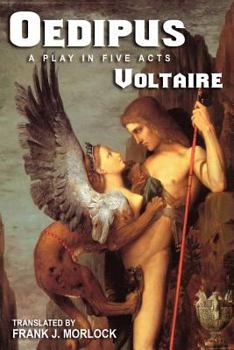
Oedipus: A Play in Five Acts
No Customer Reviews

Select Format
Select Condition 
Book Overview
Voltaire (1694-1778) was a prolific French philosopher, historian, novelist, poet, essayist--and popular playwright and opera librettist. Oedipus, produced in 1718, was his first drama, a recasting of Sophocles's play of the same name. Voltaire highlights the tension by introducing the character Philoctetes, a suitor of Queen Jocasta before she married Laius or Oedipus, and later a companion to Hercules. Philoctetes returns to Thebes, which is being punished by the gods because King Laius's murderer has not yet been punished--and becomes the chief suspect in the crime. Young King Oedipus is forced to investigate, but in the process reveals himself to be the killer--and uncovers the fact, previously unknown to him, that Jocasta is not only his wife, but his mother! The ensuing scandal destroys his family, his world, and himself. A brilliant d?but by one of the world's great writers!
Format:Paperback
Language:English
ISBN:1434444422
ISBN13:9781434444424
Release Date:March 2012
Publisher:Borgo Press
Length:148 Pages
Weight:0.50 lbs.
Dimensions:0.3" x 6.0" x 9.0"
Customer Reviews
0 rating
Copyright © 2026 Thriftbooks.com
Terms of Use | Privacy Policy | Do Not Sell/Share My Personal Information | Cookie Notice | Cookie Preferences | Accessibility Statement
ThriftBooks ® and the ThriftBooks ® logo are registered trademarks of Thrift Books Global, LLC
ThriftBooks ® and the ThriftBooks ® logo are registered trademarks of Thrift Books Global, LLC
