


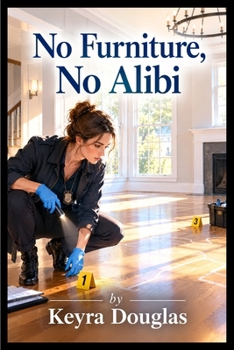
No Furniture, No Alibi

When Detective Daniel Pierce enters a million-dollar house at 14 Alden Road, he finds real-estate partner Julian Vance dead in the center of a room that appears almost unnaturally untouched. There is no blood, no sign of a struggle, and no credible way for a killer to have entered or escaped. The house's emptiness, initially dismissed as a staging choice, soon becomes the most important evidence of all. Its pristine floors show no history of furniture, and its measurements reveal that the building's interior does not match its exterior footprint.Working with forensic specialist Jasper Thorne, Daniel follows the clues hidden in echoes, wall thickness, temperature shifts, and impossible distances. Behind the immaculate plaster lies a concealed architecture that challenges the official record of the property-and suggests that the house was never meant to function as an ordinary home. As Daniel's investigation expands, he uncovers a network of hidden spaces, altered building records, and people erased through administrative decisions rather than conventional violence.The case draws him toward Genevieve Ross, Locke, and the legacy of his own father, whose plans may hold the key to a secret preserved inside the walls. The deeper Daniel probes, the more dangerous the investigation becomes: the structures he measures are tied to a system powerful enough to make people disappear and then deny that they ever existed. His instruments can expose what the blueprints conceal, but they cannot protect him from those determined to keep the truth buried.In a mystery where sound can reveal a passage and a missing measurement can expose a lie, Daniel must decide what the evidence is really telling him. The empty house is not simply a crime scene; it is part of a hidden sanctuary built around forty-two lives removed from the official world. To solve Julian Vance's death, Daniel must read the negative space behind the walls and confront the truth his family has guarded for decades. The final measurement may prove that the most important evidence is not what remains in a room, but what someone has carefully made disappear.As the case widens, Daniel must separate measurable fact from the stories authorities have built around it. The house's silence is deliberate, its geometry a record of choices made long before Vance's death. Each concealed dimension points toward the same unsettling possibility: the city's most reliable maps were designed to hide a human cost.
Customer Reviews
ThriftBooks ® and the ThriftBooks ® logo are registered trademarks of Thrift Books Global, LLC
