


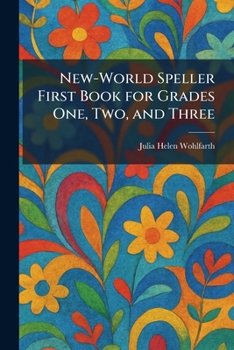
New-World Speller First Book for Grades One, Two, and Three

"New-World Speller First Book for Grades One, Two, and Three" is a comprehensive educational resource designed to guide young learners through the foundational stages of literacy and spelling. Created by Julia Helen Wohlfarth, this instructional guide focuses on the critical early years of primary education, providing a structured approach to word mastery and language development.
The work emphasizes the development of accurate spelling habits through a series of carefully curated lessons tailored to the cognitive levels of children in the first three grades. By integrating vocabulary building with phonetic understanding, the text aims to cultivate both reading and writing fluency. It serves as an insightful look into historical pedagogical methods, highlighting the systematic ways in which language arts were taught in the early twentieth century. Teachers, parents, and historians of education will find the work's rhythmic approach and graduated difficulty an effective window into the evolution of literacy instruction. From simple phonetic patterns to more complex word structures, "New-World Speller First Book for Grades One, Two, and Three" remains a significant example of early childhood educational literature.
This work has been selected by scholars as being culturally important, and is part of the knowledge base of civilization as we know it. This work was reproduced from the original artifact, and remains as true to the original work as possible. Therefore, you may see the original copyright references, library stamps (as most of these works have been housed in our most important libraries around the world), and other notations in the work.
This work is in the public domain in the United States of America, and possibly other nations. Within the United States, you may freely copy and distribute this work, as no entity (individual or corporate) has a copyright on the body of the work.
As a reproduction of a historical artifact, this work may contain missing or blurred pages, poor pictures, errant marks, etc. Scholars believe, and we concur, that this work is important enough to be preserved, reproduced, and made generally available to the public. We appreciate your support of the preservation process, and thank you for being an important part of keeping this knowledge alive and relevant.
Customer Reviews
ThriftBooks ® and the ThriftBooks ® logo are registered trademarks of Thrift Books Global, LLC
