


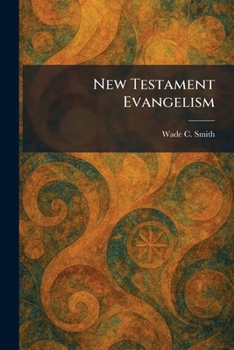
New Testament Evangelism

Select Format
Select Condition 
Book Overview
"New Testament Evangelism" explores the foundational principles and practical methods of Christian witness as established in the apostolic age. Written with the aim of revitalizing the church's commitment to the Great Commission, this work delves into the spiritual and strategic components of sharing the gospel. Author Wade C. Smith examines the New Testament record to identify the core motivations and techniques that empowered early Christians to spread their faith across the Roman world and beyond.
The book emphasizes that evangelism is not merely a program but a lifestyle of spiritual readiness and personal engagement. It covers essential topics such as the importance of individual testimony, the necessity of scriptural grounding, and the transformative power of the Holy Spirit in the lives of both the messenger and the hearer. Smith's insights provide a roadmap for believers seeking to model their outreach efforts after the successes of the primitive church.
By connecting historical precedents with timeless spiritual truths, "New Testament Evangelism" remains a valuable resource for ministers, missionaries, and laypeople alike. It offers a clear, biblically-centered perspective on the duties of the modern church, encouraging a return to the direct and fervent methods of the New Testament writers.
This work has been selected by scholars as being culturally important, and is part of the knowledge base of civilization as we know it. This work was reproduced from the original artifact, and remains as true to the original work as possible. Therefore, you may see the original copyright references, library stamps (as most of these works have been housed in our most important libraries around the world), and other notations in the work.
This work is in the public domain in the United States of America, and possibly other nations. Within the United States, you may freely copy and distribute this work, as no entity (individual or corporate) has a copyright on the body of the work.
As a reproduction of a historical artifact, this work may contain missing or blurred pages, poor pictures, errant marks, etc. Scholars believe, and we concur, that this work is important enough to be preserved, reproduced, and made generally available to the public. We appreciate your support of the preservation process, and thank you for being an important part of keeping this knowledge alive and relevant.
Customer Reviews
ThriftBooks ® and the ThriftBooks ® logo are registered trademarks of Thrift Books Global, LLC
