


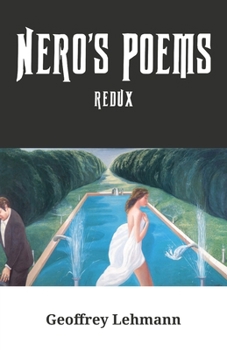
Nero's Poems Redux

In 2025 New York Review of Books published Geoffrey Lehmann's translations of Rainer Maria Rilke Fifty Poems, describing them as "equal to that of the German originals". Nero's Poems Redux - autobiographical poems of the Roman emperor Nero - is another book of astonishing translations, but they are invented translations, as only fragments of Nero's own poetry survive.
At the heart of this strange book are Nero's love of beauty and his famous last words: "Qualis artifex pereo." - what an artist dies with me - and the paradox of a mother's boy who murders his controlling mother. A more attractive person emerges than one might expect. He celebrates Rome's gardens and beggars. He delights in dinner parties: "If gods can visit men, they do at dinner among friends." On the death of his much loved empress Poppaea, he imagines himself as a new Orpheus seeking her in the underworld. And he mocks philosophers who can't understand the libidinous young:
I like making love on beaches -
anywhere in fact.
Geoff Page in Sydney Review of Books wrote of an earlier published version of these "translations" "Geoffrey Lehmann . . . has been the most protean Australian poet of his generation, a user of masks . . . Nero's poems are . . . a milieu in which he seems able to move effortlessly, quietly implying parallels with our own times while also insisting on Rome's uniqueness . . . The poems can be confronting, but they give a strong sense of a powerful man out of control, a man who will eventually be destroyed by his own excesses . . . Having heard the poet perform a number of these poems over the years, I am even more impressed by how comprehensive and psychologically convincing they are."
Begun in 1974, Nero's Poems Redux has been in gestation for more than fifty years. In the meantime some "translations" have been recital pieces at a university Rugby club's gatherings, others became a short chamber opera, The Nero Monologues with Sarah Toth, and one appeared anonymously on Reddit with a reader commenting: "I had to look up what a libation pipe was but that's also my new favorite to describe my own drinking." Rest assured the translations are now, as Nero might boast, "perfectus, totus, completus". Although heading for tragedy, readers will enjoy an exuberant romp whose young hero can truthfully say:
We cram our lives with faces and places,
lovers of the poppy
whose red petals blow away in the grass.
Related Subjects
PoetryCustomer Reviews
ThriftBooks ® and the ThriftBooks ® logo are registered trademarks of Thrift Books Global, LLC
