


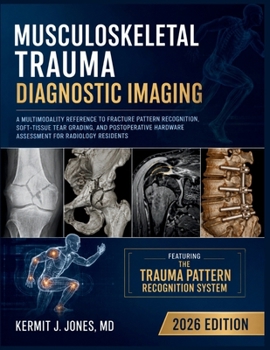
Musculoskeletal Trauma Diagnostic Imaging 2026: A Multimodality Reference to Fracture Pattern Recognition, Soft-Tissue Tear Grading, and Postoperative

Musculoskeletal Trauma Diagnostic Imaging 2026 gives radiology residents a structured way to interpret fractures, dislocations, soft-tissue injuries, pediatric trauma, safeguarding patterns, postoperative constructs, and advanced imaging protocols. Built around mechanism-based pattern recognition, it connects radiographic alignment, CT fracture geometry, MRI marrow and soft-tissue signal, ultrasound dynamics, nuclear medicine localization, and arthrographic surface assessment to the decisions that determine stability, surgery, follow-up, and urgent communication.
The book's Trauma Pattern Recognition System helps readers move from visible clue to associated-injury search, modality pivot, trap logic, and report anchor.
- Decode fracture and dislocation patterns by region - from shoulder, elbow, wrist, pelvis, hip, knee, ankle, foot, and spine trauma to the associated injuries each mechanism predicts.
- Select the right modality for the question - radiographs for alignment, CT for articular geometry and hardware trajectory, MRI for occult fracture and soft-tissue injury, and ultrasound or SPECT/CT when targeted answers matter.
- Grade tendon, ligament, muscle, meniscal, labral, cartilage, and peripheral nerve trauma - with report language that describes completeness, retraction, instability, denervation, and repair relevance.
- Interpret pediatric trauma safely - including buckle, greenstick, physeal, transitional, apophyseal, growth-arrest, and safeguarding injury patterns.
- Assess postoperative hardware by function - identifying union, nonunion, malunion, pseudoarthrosis, loosening, migration, joint penetration, infection, and recurrent soft-tissue repair failure.
- Avoid common misses and mimics - accessory ossicles, subtle dislocations, occult fractures, Lisfranc injuries, syndesmotic instability, physeal injuries, and metal-artifact pitfalls.
- Use the Master Atlas at the workstation - converting fragments, malalignment, marrow edema, hardware lucency, and repair defects into management-ready impressions.
Choose this reference to make every trauma report clearer, more complete, and more useful to the team treating the injury.
Customer Reviews
ThriftBooks ® and the ThriftBooks ® logo are registered trademarks of Thrift Books Global, LLC
