


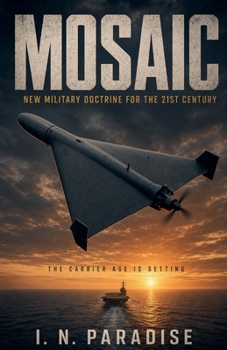
Mosaic

A $13 billion aircraft carrier. A missile that costs less than one of its aircraft. The arithmetic no longer works - and everyone's targeteers know it.
This is not a prediction. It is happening now: in Ukraine, where cheap drones burn strategic bombers in their parking rows; in the Red Sea, where warships spend multi-million-dollar interceptors against weapons costing less than a car; in the Gulf, where the world's most expensive base network is a published list of coordinates.
MOSAIC argues that the age of concentrated military power - the supercarrier, the superbase, the massed formation - is over. The future belongs to mosaic power: forces that are distributed, cheap, networked, and hard to kill. Drones are the visible tile. AI is the layer that composes surviving tiles into a fighting whole. Dispersed and hardened infrastructure is what keeps a force alive when everything visible is targetable. Separately, each is a trend. Together, they are a doctrine.
Inside, you'll discover:
Why every era's flagship was sunk by the next era's cheap weapon - and why the carrier is next in the patternThe missile math: how saturation attacks turn a defended fleet's own magazines into its fatal constraintWhy commercial satellites have ended the ocean as a hiding placeHow AI compresses the kill chain from hours toward seconds - and why the mosaic is a software doctrine that happens to wear dronesA war game in which a competent, brave, superbly equipped force loses - to a spreadsheetWhat Iran, North Korea, and Ukraine already understand about distributed and underground power that the Pentagon's budget still deniesThe six pillars of a distributed superpower - and the ten-year window to build oneWritten entirely from public sources, and steelmanning the strongest pro-carrier arguments before answering them, this is the successor to Christian Brose's The Kill Chain: Brose diagnosed the broken kill chain; this book names the disease - concentration itself.
The carrier age is setting. This book explains what rises next.
Customer Reviews
ThriftBooks ® and the ThriftBooks ® logo are registered trademarks of Thrift Books Global, LLC
