


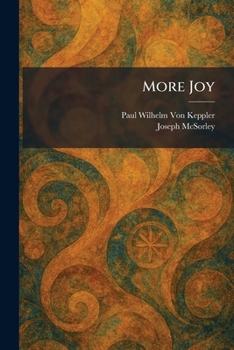
More Joy

"More Joy" is an inspiring and theological examination of the role of happiness within the Christian life. Written by the esteemed Bishop Paul Wilhelm Von Keppler, this work addresses the common misconception that a life of faith must be defined by gravity and gloom. Instead, Von Keppler makes a compelling case for joy as a fundamental virtue and a necessary component of spiritual health.
Drawing upon Scripture, the lives of the saints, and psychological insights, the book explores how believers can cultivate an enduring sense of gladness even in the face of adversity. The text provides a roadmap for moving beyond superficial pleasure toward a deep-seated spiritual joy that strengthens character and illuminates the path of devotion. This English edition, featuring contributions from The Rev. Joseph McSorley, brings Von Keppler's profound insights to a wider audience, offering a timeless perspective on the uplifting power of the Gospel.
Valued for its historical significance and its enduring spiritual relevance, "More Joy" serves as both a practical manual for personal growth and a classic piece of early 20th-century Catholic literature. It is an essential read for those seeking to enrich their spiritual journey with a renewed sense of hope and cheerfulness.
This work has been selected by scholars as being culturally important, and is part of the knowledge base of civilization as we know it. This work was reproduced from the original artifact, and remains as true to the original work as possible. Therefore, you may see the original copyright references, library stamps (as most of these works have been housed in our most important libraries around the world), and other notations in the work.
This work is in the public domain in the United States of America, and possibly other nations. Within the United States, you may freely copy and distribute this work, as no entity (individual or corporate) has a copyright on the body of the work.
As a reproduction of a historical artifact, this work may contain missing or blurred pages, poor pictures, errant marks, etc. Scholars believe, and we concur, that this work is important enough to be preserved, reproduced, and made generally available to the public. We appreciate your support of the preservation process, and thank you for being an important part of keeping this knowledge alive and relevant.
Customer Reviews
ThriftBooks ® and the ThriftBooks ® logo are registered trademarks of Thrift Books Global, LLC
