


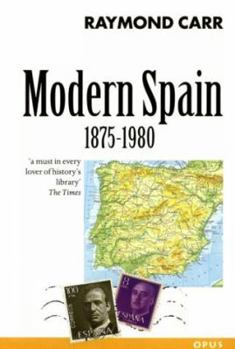
Modern Spain, 1875-1980

Select Format
Select Condition 
Book Overview
The word liberal as part of our political vocabulary, comes from Spain. It was first used to describe a group of radical patriots cooped up in Cadiz, refugees from the French invasion of 1808. In 1812 they drew up a constitution enshrining the sovereignty of the people wich struck at the very basis of the old monarchy and became the model for advanced democrats from St Petersburg to Naples. Universal male suffrage was established in Spain in 1890 - earlier than in Britain. The imposition of advanced liberal institutions on a conservative society, both economically and socially backward, inevitably caused tensions; and these, Raymond Carr argues, explain much of Spainsh history. His analysis, incorporating much new research, starts at the September Revolutionof1868 and goes rught up to the present day.
Format:Paperback
Language:English
ISBN:0192890905
ISBN13:9780192890900
Release Date:June 1981
Publisher:Oxford University Press, Incorporated
Length:256 Pages
Weight:0.42 lbs.
Dimensions:7.8" x 0.3" x 5.1"
Customer Reviews
2 ratings
quick delivery (during holiday season) and excellent condition
Published by Thriftbooks.com User , 19 years ago
i would have no reservations buying from this supplier again!
Human nature has a compound middle name: Complexity Galore.
Published by Thriftbooks.com User , 26 years ago
Those who are curious about the historical workings of modern Spanish labour and political history from 1875-1980, will serve their minds quite well in reading this title. The author, Mr. Carr, brings to the reader - an illuminating work distinctly expressing a balance of sufficient historical detail counteracted most positively, by an obligatory laconic approach.Preceding 1875, Spain's "anaemic" history of the industrialist/labourer relationship had long been existant from the 1830's. Throughout the book, the author serves to describe more or less emphatically, natural obstacles hindering the early Spanish industrial revolution. For over a thousand years, psychological and environmental differences amongst the varying regional mentalities and topograghies of the country were acutely (and still are) recognized and preserved by Castilians, Catalonians, Valencians, Asturians, Galicians, Andalusians, Aragonese, Leonese, Basques etc.Hence, nineteenth-century economic needs and demands from both labour and industrialists were always at odds from region-to-region. Augmenting this basic complexity was the growing frequency of intra-party factions, electoral manipulation, church-burning, innumerous strikes and assassinations by both civilians and, an increasingly intervening military. The core issue throughout this time period: An effective, congruous establishment of a "national economic" vision entailing long-term growth. The entry into what was considered by some to be a "Godless" era of mass-modernity, were the traditionally-minded peasants, industrialists, conservatives and churchmen - for they feared the gradual, societal disintegration of Classical, Catholic Spain.Yet astonishingly, there were those political, military, religious and civilian figures wanting to see a Spain fully industrialized via the exemplary French/English model. It is this overall social/political dichotomy (also recognized by Spaniards), that Mr. Carr gently explicates, the understanding of how such perennial intransigence (both an excellent and horrible human quality) on the part of all parties, generated the unfortunate broth for a "violent soup" that became the Spanish Civil War.Post-civil war recovery, Opus Dei, growing consumerism, transition to democracy and the restoration of monarchy are covered in more general detail.
Copyright © 2026 Thriftbooks.com
Terms of Use | Privacy Policy | Do Not Sell/Share My Personal Information | Cookie Notice | Cookie Preferences | Accessibility Statement
ThriftBooks ® and the ThriftBooks ® logo are registered trademarks of Thrift Books Global, LLC
ThriftBooks ® and the ThriftBooks ® logo are registered trademarks of Thrift Books Global, LLC
