


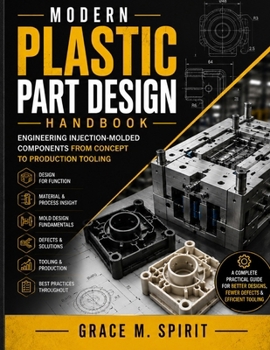
Modern Plastic Part Design Handbook: Engineering Injection-Molded Components from Concept to Production Tooling
No Customer Reviews

A plastic part that looks perfectly designed on screen can still fail the moment it reaches the mold - not because the engineering is wrong, but because the geometry and the tooling that produces it were never treated as one problem.
Many engineers arrive at plastic part design after training in general mechanical or metals-based design, where geometry is largely independent of the process that produces it. Injection molding does not work that way. A wall thickness, a rib, a boss, or a corner radius is simultaneously a decision about melt flow, cooling time, shrinkage, and ejection force. Treat these as separate concerns, and the result is a design that cannot be molded without expensive rework, or one that molds successfully but costs far more than it should because a stiffness decision quietly became a cycle-time and tooling-amortization problem.
This handbook is built around that coupling as its organizing idea. Across fourteen chapters, it moves from polymer material fundamentals through structural design, moldability rules, tolerancing, and tooling-facing topics, to prototyping and the transition into full production - carrying the same notation and numerical-example conventions forward from chapter to chapter, and functioning equally as a teaching text and a standing engineering reference.
Inside, you will be able to:
- Trace how wall thickness governs cooling time, cycle time, and tooling amortization through a first-pass cost model built from first principles.
- Apply beam and plate deflection formulas developed specifically for plastic sections, and evaluate permissible undercut depth as a function of flexural modulus and wall thickness.
- Work fully unit-tracked numerical examples, in SI with US customary values shown alongside, across structural, thermal, and moldability calculations.
- Practice structuring a formal design-for-manufacturability review, using the book's own roles, timing, and verification-checklist framework.
- Use a symptom-to-phase diagnostic reference to trace a cosmetic or dimensional defect back to the design decision that actually caused it.
- Consult appendix-level quick references for unit conversion, comparative material properties, and an index mapping every capstone procedure to its chapter and section.
- Review structured practice problems with worked answer keys throughout, suitable for self-study or as a course companion.
Coverage runs from polymer material behavior and selection, through rib and boss structural design, draft angles and undercuts, snap fits and living hinges, gating and melt-flow design, cooling system design and cycle time, warpage and residual stress, surface finish and cosmetic defects, assembly and secondary operations, and the practical steps of moving from prototype to production tooling - along with program-level frameworks for risk management, cost of quality, and sustainability.
Written for practicing mechanical and manufacturing engineers who already have a working knowledge of mechanics of materials and want a rigorous, quantitative treatment of how those fundamentals apply specifically to injection-molded parts. It also serves product design engineers, design-for-manufacturability reviewers, program managers overseeing plastic part development, and upper-level engineering students preparing for industry practice.
Add this handbook to your engineering reference shelf and begin working through a design process where part geometry and mold tooling are solved together - from first concept to production tooling.
Many engineers arrive at plastic part design after training in general mechanical or metals-based design, where geometry is largely independent of the process that produces it. Injection molding does not work that way. A wall thickness, a rib, a boss, or a corner radius is simultaneously a decision about melt flow, cooling time, shrinkage, and ejection force. Treat these as separate concerns, and the result is a design that cannot be molded without expensive rework, or one that molds successfully but costs far more than it should because a stiffness decision quietly became a cycle-time and tooling-amortization problem.
This handbook is built around that coupling as its organizing idea. Across fourteen chapters, it moves from polymer material fundamentals through structural design, moldability rules, tolerancing, and tooling-facing topics, to prototyping and the transition into full production - carrying the same notation and numerical-example conventions forward from chapter to chapter, and functioning equally as a teaching text and a standing engineering reference.
Inside, you will be able to:
- Trace how wall thickness governs cooling time, cycle time, and tooling amortization through a first-pass cost model built from first principles.
- Apply beam and plate deflection formulas developed specifically for plastic sections, and evaluate permissible undercut depth as a function of flexural modulus and wall thickness.
- Work fully unit-tracked numerical examples, in SI with US customary values shown alongside, across structural, thermal, and moldability calculations.
- Practice structuring a formal design-for-manufacturability review, using the book's own roles, timing, and verification-checklist framework.
- Use a symptom-to-phase diagnostic reference to trace a cosmetic or dimensional defect back to the design decision that actually caused it.
- Consult appendix-level quick references for unit conversion, comparative material properties, and an index mapping every capstone procedure to its chapter and section.
- Review structured practice problems with worked answer keys throughout, suitable for self-study or as a course companion.
Coverage runs from polymer material behavior and selection, through rib and boss structural design, draft angles and undercuts, snap fits and living hinges, gating and melt-flow design, cooling system design and cycle time, warpage and residual stress, surface finish and cosmetic defects, assembly and secondary operations, and the practical steps of moving from prototype to production tooling - along with program-level frameworks for risk management, cost of quality, and sustainability.
Written for practicing mechanical and manufacturing engineers who already have a working knowledge of mechanics of materials and want a rigorous, quantitative treatment of how those fundamentals apply specifically to injection-molded parts. It also serves product design engineers, design-for-manufacturability reviewers, program managers overseeing plastic part development, and upper-level engineering students preparing for industry practice.
Add this handbook to your engineering reference shelf and begin working through a design process where part geometry and mold tooling are solved together - from first concept to production tooling.
Format:Paperback
Language:English
ISBN:B0HBB81HXH
ISBN13:9798188779528
Release Date:July 2026
Publisher:Independently Published
Length:472 Pages
Weight:2.39 lbs.
Dimensions:0.9" x 8.5" x 11.0"
Customer Reviews
0 rating
Copyright © 2026 Thriftbooks.com
Terms of Use | Privacy Policy | Do Not Sell/Share My Personal Information | Cookie Policy | Cookie Preferences | Accessibility Statement
ThriftBooks ® and the ThriftBooks ® logo are registered trademarks of Thrift Books Global, LLC
ThriftBooks ® and the ThriftBooks ® logo are registered trademarks of Thrift Books Global, LLC
