


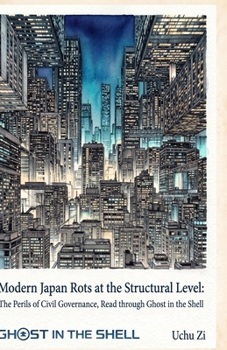
Modern Japan Rots at the Structural Level: The Perils of Civil Governance, Read through Ghost in the Shell
No Customer Reviews

Book Description
What if Ghost in the Shell is not only a vision of the future, but also a mirror reflecting the hidden failures of modern Japan? Bunchi-shugi (文治主義, civil governance through law, scholarship, administration, and institutions) appears gentler than rule by force. Yet civil governance has its own shadow. Law can protect people, but it can also silence them. Morality can warm society, but it can also burn people in the name of justice. Institutions can save lives, but they can also scatter responsibility so widely that no one looks like a villain-while irreversible tragedies are still produced. This book reads the manga Ghost in the Shell by Masamune Shirow, the anime film directed by Mamoru Oshii, and Ghost in the Shell: S.A.C. directed by Kenji Kamiyama as gateways into the structural defects of modern Japan, defined here as the period from the Meiji Restoration to the present. Using Uchu Zi's original framework, Sangen-dō (三元道, the Threefold Way), the book examines the collapse of three dimensions: the Physical, the Cognitive, and the Relational. Bodies are wounded. Information is withheld. Trust is broken. And somewhere inside the shell of the institution, the human ghost is crushed. The real-world cases discussed include the HIV-tainted blood-products scandal, the former Eugenic Protection Law, the Ashikaga wrongful-conviction case, the Hansen's disease segregation policy, the Technical Intern Training Program, the pension records scandal, the Okegawa stalking murder case, the Hakamada case, the massacres during the Great Kantō Earthquake, Minamata disease, the drug-induced hepatitis C scandal, the Fukushima Daiichi nuclear accident, the JR Fukuchiyama Line derailment, the Kotō Memorial Hospital case, and many others. This is not simply a book about "bad people." It asks a deeper question: What kind of structure allowed the tragedy to happen? Why could the people who were there not stop it? Why did institutions protect themselves before protecting the victims? Why do organizations bury human pain inside jurisdictional boundaries, paperwork, precedents, technical language, meetings, approval procedures, and reports? And why, after tragedy occurs, does society often rush toward kajō-seigi (過剰正義, overzealous justice: the impulse to expose, punish, and condemn someone publicly) before repairing the structure that produced the harm? In Ghost in the Shell, cyberbrains, prosthetic bodies, ghosts, AI, networks, states, and information warfare may appear to belong to the future. A cyberbrain (電脳) is a networked mind. A prosthetic body or cyborg body (義体) is an artificial body. A ghost (ゴースト) is the inner self, consciousness, soul, or irreducible human presence within the world of the work. But every society also has its own shell. And a shell can protect the ghost-or imprison it. Before blaming people, examine the vessel. Before praising institutions, look at the human beings weeping outside them.Format:Paperback
Language:English
ISBN:B0H779FW3K
ISBN13:9798185173664
Release Date:July 2026
Publisher:Independently Published
Length:522 Pages
Weight:1.19 lbs.
Dimensions:1.3" x 5.5" x 8.5"
Customer Reviews
0 rating
Copyright © 2026 Thriftbooks.com
Terms of Use | Privacy Policy | Do Not Sell/Share My Personal Information | Cookie Policy | Cookie Preferences | Accessibility Statement
ThriftBooks ® and the ThriftBooks ® logo are registered trademarks of Thrift Books Global, LLC
ThriftBooks ® and the ThriftBooks ® logo are registered trademarks of Thrift Books Global, LLC
