


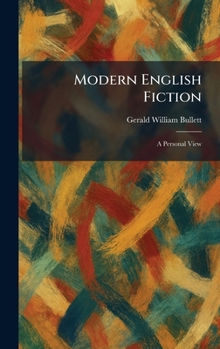
Modern English Fiction: A Personal View

"Modern English Fiction, a Personal View" offers an insightful and contemporary exploration of the landscape of British literature during the early twentieth century. Written by Gerald William Bullett, a noted novelist and critic, this work provides a subjective yet deeply informed analysis of the evolving forms and themes of the English novel. Bullett examines the literary trends of his time, offering critical perspectives on the works and techniques of his contemporaries.
The book serves as an important historical document for understanding how modernism and post-Victorian realism were perceived by critics of the era. Through a series of engaging essays, the author evaluates the artistic merits and cultural impact of key writers, providing readers with a window into the intellectual climate of the 1920s. This volume is essential for students of literary history, scholars of the modern novel, and anyone interested in the development of English prose. It captures a moment of significant transition in the literary world, highlighting the shift toward new narrative methods and psychological depth that would come to define modern fiction.
This work has been selected by scholars as being culturally important, and is part of the knowledge base of civilization as we know it. This work was reproduced from the original artifact, and remains as true to the original work as possible. Therefore, you may see the original copyright references, library stamps (as most of these works have been housed in our most important libraries around the world), and other notations in the work.
This work is in the public domain in the United States of America, and possibly other nations. Within the United States, you may freely copy and distribute this work, as no entity (individual or corporate) has a copyright on the body of the work.
As a reproduction of a historical artifact, this work may contain missing or blurred pages, poor pictures, errant marks, etc. Scholars believe, and we concur, that this work is important enough to be preserved, reproduced, and made generally available to the public. We appreciate your support of the preservation process, and thank you for being an important part of keeping this knowledge alive and relevant.
Customer Reviews
ThriftBooks ® and the ThriftBooks ® logo are registered trademarks of Thrift Books Global, LLC
