


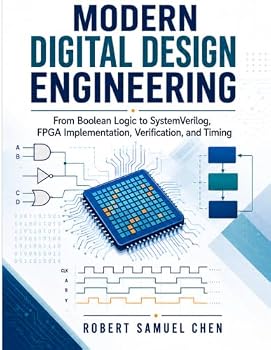
Modern Digital Design Engineering: From Boolean Logic to SystemVerilog, FPGA Implementation, Verification, and Timing

Modern Digital Design Engineering is a practical, SystemVerilog-first textbook for readers who want to move beyond truth tables and isolated HDL examples and learn how digital hardware is actually designed, verified, timed, implemented, and debugged.
Starting with number systems, Boolean algebra, logic gates, and Karnaugh maps, the book builds step by step into the structures used in real RTL and FPGA work.
Design combinational and sequential hardware: decoders, multiplexers, arithmetic circuits, registers, counters, timers, finite-state machines, datapaths, and controllers.Write synthesizable SystemVerilog: modules, always_comb, always_ff, parameters, arrays, generate constructs, reusable RTL, and clear coding patterns that describe hardware rather than software.Develop verification habits: self-checking testbenches, assertions, randomized stimulus, scoreboards, coverage concepts, X/Z reasoning, and waveform-based debugging.Understand FPGA implementation: LUTs, flip-flops, carry chains, block RAM, DSP resources, synthesis, placement, routing, utilization reports, and bitstreams.Engineer reliable timing and clocking: propagation delay, setup and hold, slack, clock skew, jitter, reset strategy, metastability, synchronizers, clock-domain crossing, and timing closure.Move data and connect hardware: memories, FIFOs, UART, SPI, I2C, GPIO, PWM, debouncing, peripheral timing, and practical hardware bring-up.Integrate the full system: finish with a compact 16-bit educational computer that brings together an ALU, register file, controller, memory, branches, I/O, verification, and FPGA-oriented implementation thinking.Throughout the book, concepts are connected through the recurring engineering chain Requirement → Logic → Architecture → RTL → Verification → Timing → Implementation → Debugging. Common failure examples show not only what works, but why designs break and how to diagnose them.
Ideal for: electrical and computer engineering students, computer science students studying digital systems, technicians moving into FPGA work, embedded developers, self-taught hardware designers, and instructors seeking a practical supplementary text.
If you want a modern bridge between university digital-logic theory and the first year of practical FPGA/RTL engineering, this book is built for that transition.
Customer Reviews
ThriftBooks ® and the ThriftBooks ® logo are registered trademarks of Thrift Books Global, LLC
