


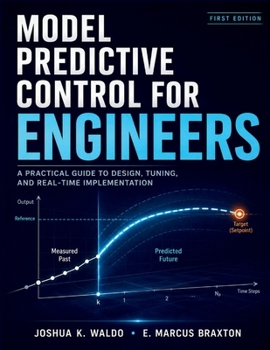
Model Predictive Control for Engineers: A Practical Guide to Design, Tuning, and Real-Time Implementation

Every engineer eventually meets a control problem that reactive feedback cannot solve alone-interacting loops fighting each other, a delayed response arriving after the correction meant for it, or a hard operating limit that must be respected exactly rather than approached with a cautious margin.
Classical feedback control reacts only to the error it currently observes; it has no internal model of the process and no way to anticipate what a control move will do several steps ahead. Predictive control answers this with one structural change-placing a model of the process inside the controller-but the gap between understanding that idea and actually designing, tuning, and deploying a working controller is where most engineering references fall short, staying too abstract to build from or asking the reader to trust results that were never actually verified.
This comprehensive, sixteen-chapter guide closes that gap, developing predictive control as one continuous, verified discipline-from the discrete-time models a controller predicts from, through the optimization machinery that makes constrained control tractable, to a controller running safely on real industrial equipment-with every equation and worked example checked directly against independent computation.
What You'll GainUnderstand precisely why model-based, anticipatory control succeeds where reactive feedback struggles with delay, multivariable interaction, and hard operating constraints.Build the discrete-time process models a predictive controller depends on, and learn to judge whether a given model is trustworthy enough to design from.Assemble a complete optimization-based control problem and apply a systematic, evidence-based tuning procedure in place of trial-and-error adjustment.Extend a working linear design to nonlinear dynamics, uncertain models, economically optimized objectives, and coordinated multi-controller architectures.Recognize when a precomputed control law can replace an online optimization for resource-constrained hardware, and verify it reproduces the same result.Follow a controller through commissioning, validation, independent safety integration, and long-term maintenance, illustrated with four worked deployment case studies spanning chemical processing, robotics, transportation, and building systems.Use five in-depth appendices covering the mathematical prerequisites as a self-contained reference whenever a gap in background appears.Key Topics CoveredDiscrete-time system modeling; convex optimization foundations; the full linear predictive-control formulation, unconstrained and constrained; provable closed-loop stability; systematic tuning; state estimation and offset-free tracking; nonlinear predictive control and its real-time solution methods; robust and stochastic treatments of model uncertainty; economically optimized objectives; precomputed control laws; distributed and hierarchical multi-controller coordination; and industrial deployment, safety integration, and lifecycle maintenance.
Who This Book Is ForPracticing engineers across process, automation, robotics, and automotive control roles who need to move beyond reactive feedback control, and graduate-level engineering students building a rigorous, verified foundation in predictive control. Readers should be comfortable with linear algebra, ordinary differential equations, and classical feedback control; no prior background in optimization theory or predictive control specifically is assumed.
Begin building a clearer, verified understanding of predictive control with a guide designed to be consulted throughout an entire engineering career-get your copy and start from first principles through real-world deployment.
Related Subjects
Engineering Science Science & Math Science & Scientists Science & Technology TechnologyCustomer Reviews
ThriftBooks ® and the ThriftBooks ® logo are registered trademarks of Thrift Books Global, LLC
