


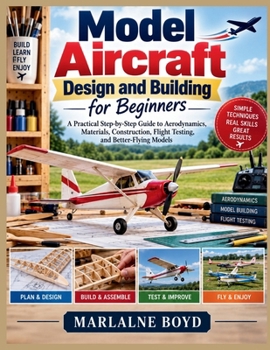
Model Aircraft Design and Building for Beginners: A Practical Step-by-Step Guide to Aerodynamics, Materials, Construction, Flight Testing, and Better-

Have you ever looked at a model airplane and wondered what actually makes it stable, efficient, and capable of smooth, predictable flight?
Model Aircraft Design and Building for Beginners takes you from basic aviation principles to the exciting moment when a carefully constructed creation leaves your hands and takes to the air.
Written for newcomers, this practical guide explains how wings, fuselages, tails, balance, structural strength, propulsion, and control systems work together-without burying you in unnecessary technical complexity.
Whether you want to build traditional balsa airplanes, gliders, powered craft, or radio-controlled projects, you will develop a foundation that helps you understand not only how to assemble them, but why they behave the way they do.
GO FROM IDEA TO AIRWORTHY CREATION
Understand lift, drag, weight, thrust, stability, and other fundamental principles in approachable language
Learn how wings, fuselages, tail sections, and control surfaces influence performance
Explore commonly used woods, foams, adhesives, coverings, and workshop supplies
Develop cleaner cutting, shaping, joining, sanding, alignment, and assembly habits
Understand balance and center-of-gravity placement before attempting a launch
Explore basic propulsion concepts involving motors, propellers, batteries, and power systems
Learn how rudders, elevators, ailerons, and other controls affect movement
Develop a systematic approach to trimming, initial launches, adjustments, and performance evaluation
UNDERSTAND WHY AIRPLANES FLY
Successful aeromodelling becomes much easier when you understand what the airframe is trying to accomplish.
Why does wing shape matter?
What happens when the center of gravity moves too far backward?
Why can excess weight reduce performance?
How do tail surfaces contribute to stability?
Instead of treating these ideas as mysterious technical concepts, this book connects them directly to the projects you build.
BUILD STRAIGHTER, STRONGER AIRFRAMES
Small inaccuracies can create surprisingly large effects once a craft is airborne.
A warped wing, misaligned tail, weak joint, or unnecessary weight can change how the finished project performs.
Learn how careful measuring, alignment, material selection, adhesives, reinforcement, sanding, and finishing contribute to cleaner construction and more dependable results.
CHOOSE MATERIALS WITH PURPOSE
Different materials offer different advantages.
Balsa can provide lightweight traditional structures.
Foam can simplify certain forms.
Different adhesives vary in strength, weight, working time, and suitability.
Coverings can influence both appearance and performance.
Understanding these tradeoffs helps you make deliberate choices instead of simply using whatever is available.
BALANCE BEFORE YOU LAUNCH
A beautifully constructed airplane may still perform poorly if it is incorrectly balanced.
Learn why center of gravity, weight distribution, wing alignment, control positioning, and structural symmetry should be checked before a first attempt.
A careful preflight routine can help identify problems while they are still easy to correct.
TEST, OBSERVE, AND IMPROVE
The first launch is not the end of the process.
It is the beginning of refinement.
Observe how your creation climbs, turns, glides, stalls, or loses altitude. Then use those observations to make measured adjustments.
This cycle of building, testing, evaluating, and improving is one of the most rewarding parts of aeromodelling.
Customer Reviews
ThriftBooks ® and the ThriftBooks ® logo are registered trademarks of Thrift Books Global, LLC
