


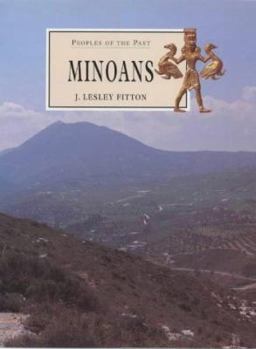
Minoans (Peoples of the Past)


Who were the Minoans, and what is interesting about them? This book assesses what we really know about the Minoans' life and times, defining the essential characteristics of a distinctive Cretan culture and setting it within its contemporary historical context. The author discusses the major themes of daily life, such as social and economic organization, agriculture, architecture and religion, drawing upon information retrieved from archaeological research.
Format:Hardcover
Language:English
ISBN:0714121401
ISBN13:9780714121406
Release Date:July 2002
Publisher:British Museum Press
Length:200 Pages
Weight:1.86 lbs.
Dimensions:9.5" x 6.7"
Customer Reviews
2 ratings
Wise, balanced, trustworthy . . .
Published by Thriftbooks.com User , 16 years ago
I found what I was hoping for with this book. What I did not want was rash speculations or modern mythologies of Minoans as a pacifist's Eden. Neither did I want a list of archaeological finds dryly reported for us to make sense of. Fortunately, Fitton had a nice way of summing up and synthesizing the important trends for us, then selecting a few examples that best show her point. Her humble attitude is what I hope for from prehistorians, essentially: "We can't know for sure what the truth was, so let me review four or five competing theories, then I'll you which I think is best and why." (My words). Or as she puts it, "Minoan society is incompletely understood, but that should not mean that it becomes a source for wild reconstructions or outlandish interpretations. The truth as we understand it is more subtle and complex and perhaps stranger than fiction: in so far as we are able, we must let the facts speak for themselves. Then, if elusively and only partially, the people will emerge from the works that they have left behind." I wanted to write this review as a contrast to the other review, which almost prevented me from buying this book. I'd like to (respectfully and politely) disagree with the reviewer. Birkett provides an example of what he or she considered to be a typical sentence. As I suspected, it's actually one of the more complicated sentences in the book, but one which makes sense in context. Minoan history is divided into three large eras, Early Minoan, parts 1, 2, & 3; Middle Minoan, parts 1, 2, & 3; and Late Minoan, parts 1, 2, & 3. Thus, we learn through reading the book that a code as seemingly daunting as "EM III-MM 1A" means the transitional period going from the Early Minoan age into the Middle Minoan age. A peek at the time line provided tells us this is happening from around 2200 BC to 2000 BC. For comparison's sake, here is an example of a sentence that I would consider typical: "The Cretan bulls so prominent in Minoan art and ritual must have been the largest animals that most Minoans ever saw." Also, I found that Linear A is mentioned on 18 pages in the book. I agree that the last chapter is most fun, but this is because Fitton's discussing myths and legends, not facts. (I'm not trying to suggest that Birkett's review is not fair or legitimate- It is. I just thought a different opinion would help inform buyers.) But the publishers can kick themselves for stupidly not letting us buyers "Look Inside" the book, preventing everyone from seeing for themselves what's in the pages. Thus, let me break down the contents for them. Chapter 1: Geography, Landscape, and Chronology. (Agriculture, Animal Husbandry, and the Use of Wild Resources; Raw Materials for Building and Crafts; Historical Outline; Absolute Chronology) Chapter 2: Crete Before the Palaces. (The Earliest Inhabitants; Early Minoan I;Early Minoan II; Early Minoan III and Middle Minoan IA; Religion in the Period before the Palac
Just the facts
Published by Thriftbooks.com User , 22 years ago
It's a book for serious students more than the general public. A typical sentence is "Construction of the tholos tomb C at Phourni was dated by the excavators to EM III, but a recent study has shown that the earliest burial layer in the tomb is of EM IIA date underlying an EM III-MM 1A level." Fitton is determined to avoid unwarranted crackpot speculation, and she succeeds all too well. She sticks to the facts so effectively that she leaves out a lot of the interesting stuff. For example there's not a word about the Phaistos disk, in fact very little about epigraphy, and only one sentence about the possible language of Linear A.In describing the Akrotiri frescoes she goes into detail about the chemical nature of the pigments but avoids any wild guesses about the intriguing question of what the characters depicted are doing. I enjoyed the last chapter best, where she finally lets her hair down and relates the archeology to some of the Greek myths and historical legends about King Minos and Ariadne. It might be of interest if you're visiting Crete (or live in Crete) and are able to spend several days at the sites she describes in detail, and "The Blue Guide to Crete" isn't quite enough for you. It has little of the excitement of "The Decipherment of Linear B".
Copyright © 2026 Thriftbooks.com Terms of Use
| Privacy Policy | Do Not
Sell/Share My Personal Information | Cookie Policy | Cookie Preferences | Accessibility Statement
ThriftBooks® and the ThriftBooks® logo are registered trademarks of Thrift Books Global, LLC
ThriftBooks® and the ThriftBooks® logo are registered trademarks of Thrift Books Global, LLC
