


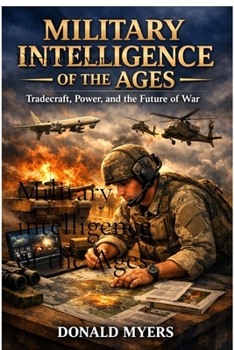
Military intelligence of the Ages

Across the span of human conflict, one truth has remained constant: wars are not won by strength alone, but by the minds capable of seeing what others cannot. Military Intelligence of the Ages traces that truth from the earliest empires to the modern battlefield, revealing how information-gathered, interpreted, and acted upon-has shaped the rise and fall of nations.
This work explores the evolution of intelligence from ancient scouts and coded messengers to the sophisticated networks of analysts, linguists, cryptographers, and field operatives who define today's strategic landscape. It examines how early civilizations used terrain, deception, and human observation to outmaneuver stronger foes; how medieval kingdoms relied on spies, informants, and secret correspondence; and how the industrial age transformed intelligence into a disciplined craft capable of influencing global outcomes.
As warfare advanced, so did the need for clarity in chaos. The book follows the development of reconnaissance, counterintelligence, psychological operations, and the birth of modern signals and imagery collection. It highlights pivotal moments when intelligence changed the course of history-battles avoided, invasions thwarted, alliances forged, and threats neutralized before they could ignite.
Yet this is more than a historical survey. It is a study of the human element behind intelligence: the analysts who sift meaning from fragments, the leaders who must make decisions with imperfect information, and the quiet professionals whose work rarely sees daylight but shapes the safety of nations. It reflects on the moral weight carried by those who operate in the shadows, the discipline required to separate truth from noise, and the timeless challenge of predicting human behavior in moments of crisis.
Military Intelligence of the Ages shows how the craft has expanded beyond the battlefield into diplomacy, technology, cyber operations, and global security. It underscores the reality that intelligence is not merely about secrets-it is about understanding people, cultures, motivations, and the unseen forces that drive conflict.
From ancient watchtowers to modern command centers, this book reveals the enduring principles that guide intelligence work: vigilance, discernment, adaptability, and the relentless pursuit of clarity. It is a tribute to the men and women across history who have stood at the intersection of danger and decision, turning information into action and safeguarding the future through the quiet power of knowledge.
Customer Reviews
ThriftBooks ® and the ThriftBooks ® logo are registered trademarks of Thrift Books Global, LLC
